

You’re typing an email to your music teacher and your fingers freeze. Is it chello or cello? It happens to music students, parents, and even seasoned writers.
Here’s the short version. Cello is the correct spelling, and chello is a spelling mistake. Keep reading and you’ll learn why the confusion exists, how to remember the correct form, and how to write it confidently anywhere.
Chello or Cello: Quick Answer
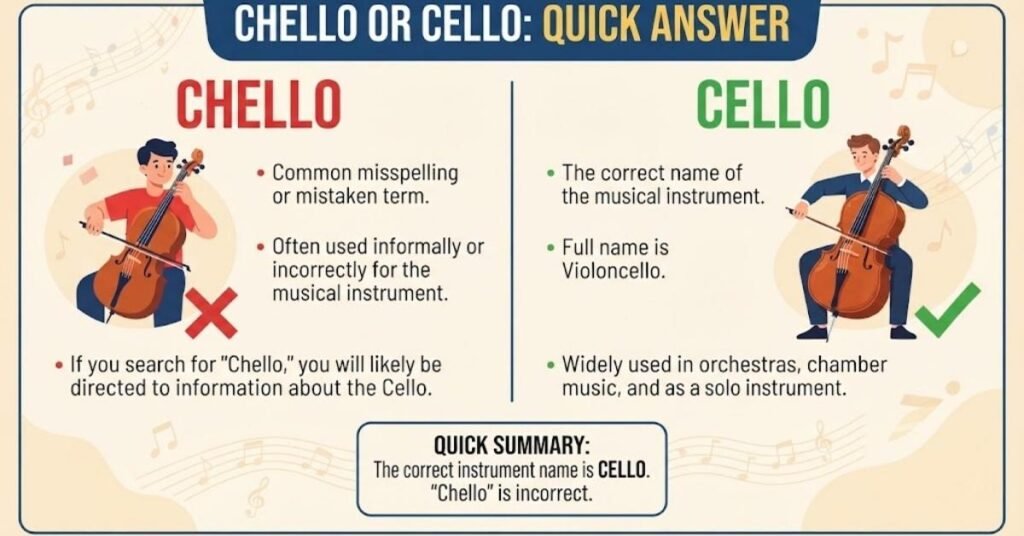
The correct musical instrument name is cello. It’s the standard form in standard English, and every major dictionary lists it that way. Chello isn’t a real word in the English language.
So why does the wrong version look so tempting? Because we say it with a “ch” sound. Your ear hears one thing, and your eyes expect another.
Examples
Here are a few sentences that show the correct spelling in action:
- She started learning cello when she was eight.
- The cello player tuned up before the orchestra began.
- Our school hired a cellist for the winter concert.
- I booked cello lessons for Saturday mornings.
Now the wrong versions, so you can spot them quickly:
- Incorrect: He plays the chello in a band.
- Correct: He plays the cello in a band.
The Origin of Chello or Cello

The word cello comes from Italian. It’s short for violoncello, an Italian term that shows up in European classical music during the 17th century. The instrument history goes back a bit further, but the name stuck in that era.
Here’s the fun part. Violoncello is built from violone, a big bass viol, plus a small ending. People often explain the word origin as a “small large viola” or “little big viol.” It sounds odd, but it made sense to musicians who were naming a smaller cousin of a giant instrument.
Over the centuries, speakers clipped violoncello down to cello. Older books sometimes print it as ‘cello, with a tiny apostrophe at the front to show the missing letters. That mark has faded out, and plain cello is the standard form today.
Why Do People Write Chello? The Pronunciation Trap
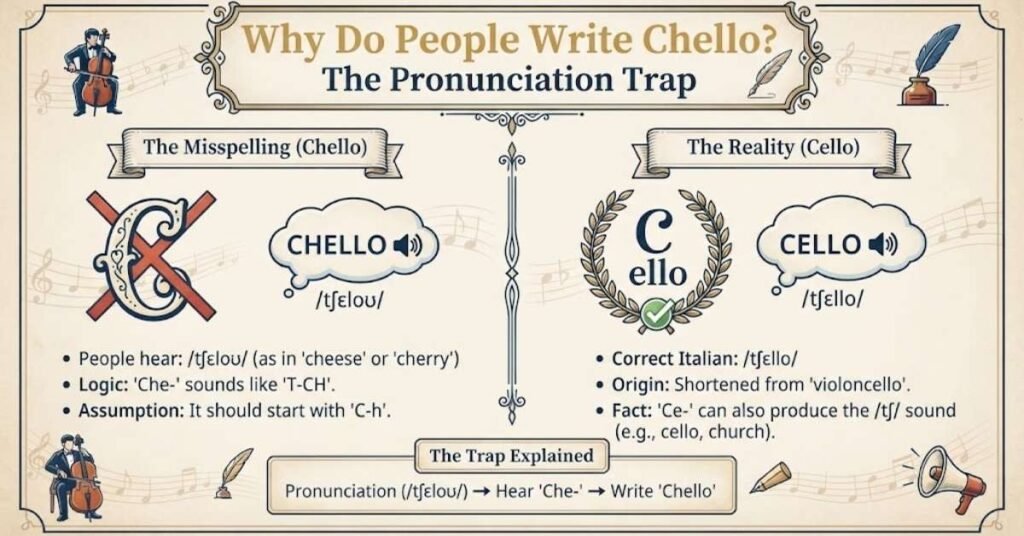
Say the word out loud: “CHEL-oh.” That opening “ch” sound is the culprit. In Italian, the letter c before an e makes a “ch” sound, and English borrowed the pronunciation along with the word.
That’s a classic case of pronunciation confusion. Your brain hears a “ch” and reaches for the letters C and H. This kind of phonetic spelling mistake is common with loanwords, and it isn’t a sign you’re careless.
Think of other words with the same quirk. Concerto and cappella follow the same Italian sound rules, and they trip up writers too. Once you know the pattern, the cello spelling feels logical instead of random.
British English vs American English Spelling
Good news here. There’s no spelling variation between British English and American English for this word. Both write cello. You won’t find a “cello versus cellO” situation like colour and color.
That means British and American English agree, and so do Canadian and Australian writers. If you work with international readers, you can relax. The spelling in the UK and the spelling in the US are identical.
Plurals are where small regional variation can show up. Most people write cellos, which is the everyday form. Some music writing uses the Italian plural celli, and you’ll see it in older scores and a few formal music articles.
Which Spelling Should You Use?
Use cello. Every time. That goes for emails, school assignments, professional writing, and a quick text to a friend.
If you’re unsure, check a dictionary. Dictionaries from Oxford, Merriam-Webster, and Cambridge all list cello as the correct English word. You won’t find chello as an entry, and that tells you everything.
Quick rule of thumb: if the word names the large string instrument that sits between your knees, it starts with a plain C. The bow and the “ch” sound are separate stories.
Common Mistakes with Chello or Cello
Most common spelling mistakes here fall into three buckets. Once you know them, you’ll catch them in your own drafts. Let’s walk through each one.
Mistake 1: Writing “Chello”
This is the big one. People type chello because it matches the sound. But it’s an incorrect spelling every time, even though it looks natural.
A spell checker will usually flag it. If you ignore the red underline, you might send a typo to a professor or a music director. That’s an easy fix with one extra glance.
Mistake 2: Adding an Apostrophe or Odd Capital
Some writers still type ‘cello with a leading apostrophe because they saw it in an old book. Others write CELLO or Cello in the middle of a sentence. Neither is needed in modern standard English.
Use lowercase cello unless it starts a sentence or sits in a title. Skip the apostrophe. It makes your writing look dated.
Mistake 3: Wrong Plurals and Possessives
You might see “cello’s” used as a plural, as in “three cello’s on stage.” That’s wrong. The plural is cellos with no apostrophe.
Use “cello’s” only for possession. For example, “the cello’s strings were brand new.” That one habit cleans up a lot of school work and music conversations.
Chello or Cello in Everyday Examples
Seeing the word in real settings helps it stick. Here’s how the correct spelling looks across four common situations. Each example shows how everyday communication works when you get it right.
Imagine you’re writing to a music teacher. A clean message might say: “Hi Ms. Carter, I’d like to book cello lessons for my daughter starting in November.” Simple and clear.
Compare that with “chello lessons.” The meaning survives, but the typo can make you look rushed. In professional communication, small details earn trust.
News
News outlets always use cello. A headline might read: “Young cellist wins national award for cello performance.” Editors check this spelling closely.
If you’re writing a school newspaper or a local blog, follow that lead. Readers notice when a music article gets an instrument name wrong.
Social Media
On social media, people post fast and spell loosely. You might see a caption like “Practice makes progress, day 40 of cello practice.” Hashtags like #cello also help your post reach music lovers.
Tagging with the wrong spelling can hide your post from your audience. Search engines and in-app search both rely on the standard word. Typing cello helps the right people find you.
Formal Writing
In essays, grant applications, and program notes, formal writing demands accuracy. A concert program might say: “The chamber orchestra will perform Elgar’s Cello Concerto.” Notice the capitals in the title only.
If you’re writing for a college application or a professional portfolio, spell it right. It signals care and writing confidently without drawing attention to itself.
Chello or Cello: Google Trends and Usage Data
Google Trends is a handy free tool for checking search interest. You can type chello and cello side by side and compare the lines. In practice, “cello” dominates, while “chello” shows up as a small spelling variant.
I’m not quoting exact numbers here, because search data changes all the time. Open Google Trends yourself for the latest picture. Treat any article that gives precise figures without a source with some caution.
Why do people search “chello or cello” at all? They want a quick spelling check. Typical search queries include “is chello a word” and “cello spelling,” which signals pure spelling confusion, not a serious dispute.
Countries with High Search Interest
Interest in this topic tends to cluster where English is widely used or studied. Compare the United States, the United Kingdom, Canada, Australia, and Germany in Google Trends to see how they stack up. Each one has a big music education scene.
Check the “Interest by region” panel and filter by time range. You can also compare online searches across the past twelve months to see seasonal spikes. Back to school season often brings more music students and beginners to the topic, which is worth testing yourself.
Comparison Table: Chello vs Cello
This quick table sums up the cello vs chello question. It’s handy to screenshot or save for later.
| Feature | Chello | Cello |
| Correct spelling | No | Yes |
| Real English word | No | Yes |
| Origin | Phonetic spelling mistake | Short for violoncello (Italian) |
| Found in dictionaries | No | Yes |
| British English | Not used | Cello |
| American English | Not used | Cello |
| Plural | None | Cellos or celli |
| Safe for emails and essays | No | Yes |
The pattern is clear. One column is a typo, and the other is the standard form used worldwide.
How to Remember the Correct Spelling
Try a simple memory trick. The word cello begins with the same letter as “classical.” Both start with C, and classical music is where the instrument shines.
Another trick: cello has two Ls in the middle, just like “bell” or “hello.” Picture a bell ringing a deep, warm tone. That image ties the spelling to the sound.
Or use the violoncello shortcut. If you ever doubt yourself, expand the word in your head: vio-lon-cello. The ending lines up with the short form, and no “h” appears anywhere in sight.
A Quick Look at the Cello Itself
Knowing the instrument makes the word feel less abstract. The cello is a string instrument in the violin family, alongside the violin, viola, and double bass. It’s a large string instrument that you play seated, with the body resting between your knees.
You make deep sounds by drawing a bow across four strings, though players also pluck them. Many listeners describe the tone as deep and rich musical sounds that feel close to the human voice. That warmth is why the cello appears in everything from chamber music to film scores and modern music.
You’ll find the cello in a standard orchestra, in string quartets, and in many classical music groups. It’s a core orchestral instrument that carries orchestral music with depth. Pieces like Bach’s cello suites show how powerful a single player can be.
Cello Spelling for Students and Beginners
If you’re a student, this section is for you. Teachers see chello all the time in school work, and most of them are kind about it. Still, tidy spelling helps your grades and your confidence.
Add the word to your practice notebook and write it a few times. Cello practice logs, lesson notes, and concert reports all benefit from the habit. It takes thirty seconds and saves you from repeated typos.
If you’re just learning instruments, start by saying the word slowly: “CHEL-oh.” Then spell it out: C, E, L, L, O. Matching sound and letters trains your brain to separate the pronunciation mistake from the correct form.
Conclusion
The answer is simple: cello is correct, and chello is a misspelling. The “ch” pronunciation causes the slip, but the word’s Italian roots explain the real spelling. Use cello in emails, essays, captions, and formal writing.
Got a spelling you always second guess? Drop it in the comments and let’s sort it out together. If this helped, share it with a friend who’s picking up the cello this year.
FAQs
1. Is chello a real word?
No. Chello is a phonetic spelling mistake and doesn’t appear in standard dictionaries. The correct English word is cello.
2. What is a cello?
A cello is a large string instrument in the violin family that you play seated, using a bow. It produces deep and rich musical sounds and is a key part of classical music.
3. Why do people write chello?
Because of the “ch” sound at the start of the word. The Italian spelling uses a soft c, so the pronunciation doesn’t match the letters English speakers expect.
4. Is cello used in orchestras?
Yes. The cello is a core orchestral instrument in the string section. You’ll also hear it in chamber music, string quartets, and modern music ensembles.
5. Do British and American English spell cello differently?
No. Both British English and American English use cello. There’s no regional variation for this word.
6. What family of instruments does the cello belong to?
It belongs to the violin family of string instruments. That family includes the violin, viola, cello, and double bass.
7. Is cello difficult to learn?
It takes patience, like any instrument. The cello has no frets, so you train your ear for pitch, but regular lessons and steady practice help beginners progress well.