
Scroll through any social media app today and you will likely spot the letters “DM” somewhere on your screen. Maybe a friend commented “DM me” under your post, or a brand replied to your question asking you to check your inbox. For anyone new to online chatting, this small term can feel confusing at first, especially since it shows up in so many different places with slightly different uses.
The good news is that DM is actually a very simple idea once you understand it. It is not a hard tech term or a hidden code. It is just a common short form that has become part of everyday online language. This guide walks you through everything you need to know about DM, from its real meaning and history to how it is used on different apps, so you can use and understand it with full confidence.
If you have ever seen someone type “DM me” on Instagram or WhatsApp and wondered what it actually means, you are not alone. This short term shows up everywhere online, from casual chats to business pages. This guide breaks down everything about DM in simple words, so you never feel confused again.
What Does DM Mean in Text & Chat?
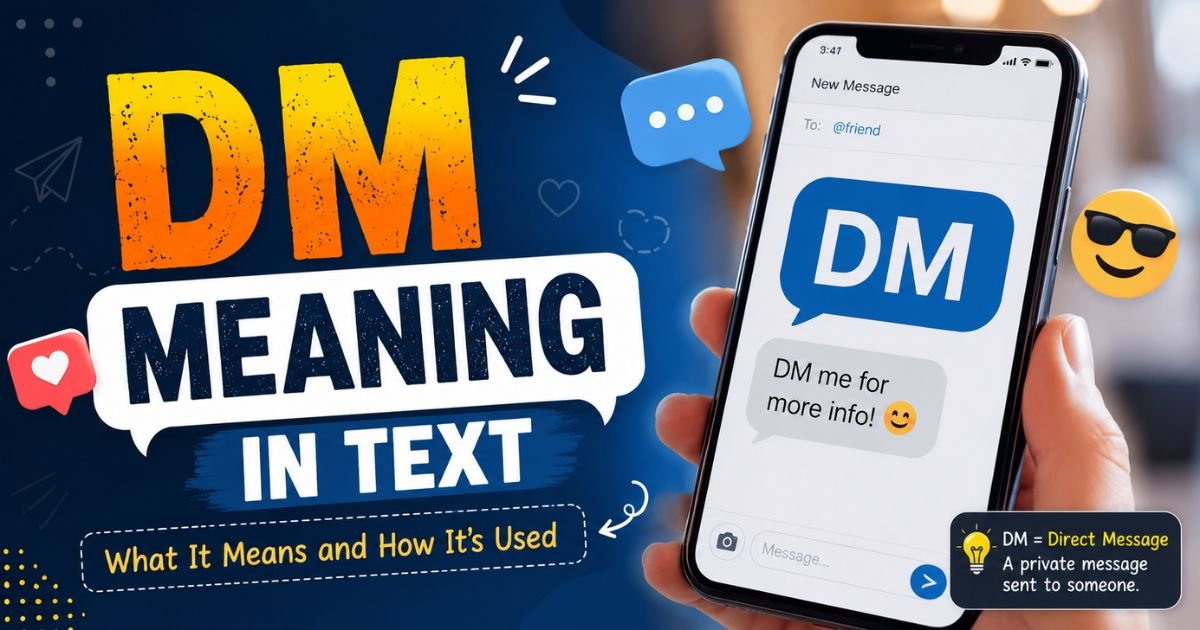
DM stands for Direct Message. It is a private message sent from one person to another, away from public comments or group chats. When someone says “DM me,” they are asking you to message them privately instead of replying in public.
This term is used across almost every messaging and social media platform today. It works the same way whether you are on a phone or a computer. The idea is simple: keep the conversation just between you and the other person.
People use DM when they want privacy, when they want to share something personal, or when a topic does not belong in a public comment section. It has become one of the most common short forms in online communication.
Full Form, Stands For & Short Meaning of DM
The full form of DM is Direct Message. Some people also read it as Direct Messaging when talking about the action itself, rather than a single message.
Here is a quick breakdown:
| Term | Meaning |
| DM | Direct Message |
| DM’ing | Sending a direct message |
| DMs | Multiple direct messages, or a person’s private inbox |
| DM me | Please send me a private message |
In short, DM simply means a private, one-on-one message sent through a chat or social app. It is not a public post, and it is not visible to anyone else unless the two people involved choose to share it.
Origin, History & First Known Use of DM
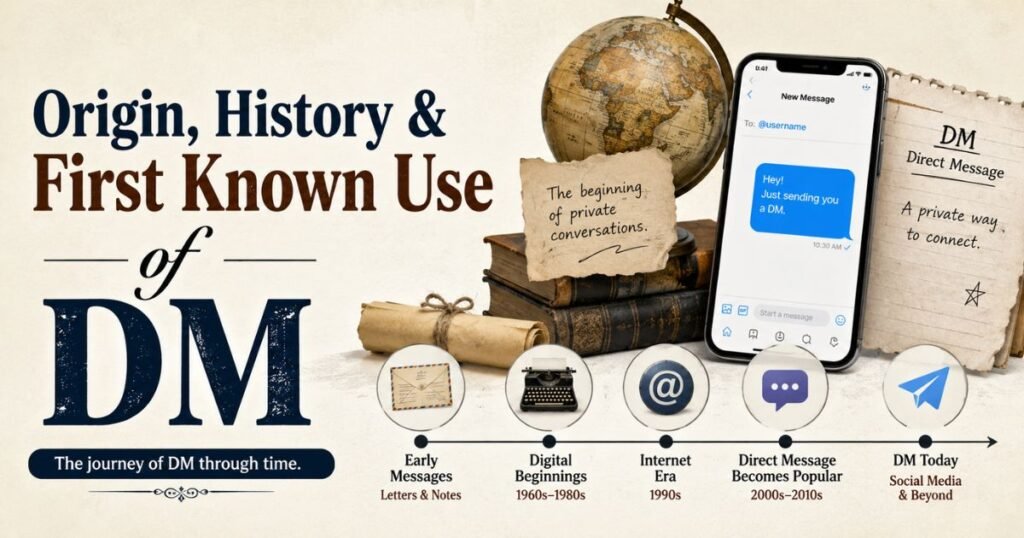
The term DM became popular with the rise of Twitter, now known as X. Twitter introduced a private messaging feature early on, and users started calling it “DM” as a short and easy way to describe it.
Before smartphones and social apps, people used the word “private message” or “PM” on forums and early chat rooms. As Twitter grew in the mid to late 2000s, DM slowly replaced PM as the more common term, especially among younger users.
Other platforms like Instagram, Facebook, and TikTok later added their own private messaging systems. They kept the same term because it was already familiar to millions of users. This made DM a universal word across almost all social platforms.
Today, DM is not just internet slang anymore. It has become a normal part of everyday English, even used in spoken conversations and business settings.
How People Use DM in Daily Conversations
DM is used in many different ways depending on the situation. Sometimes it is a request, sometimes it is a statement, and sometimes it works as a verb.
Common ways people use DM in daily chats:
- “DM me your address” – asking someone to send private details
- “I’ll DM you later” – planning to send a private message soon
- “Check your DMs” – reminding someone to look at their private inbox
- “Slide into DMs” – sending a private message, often to start a conversation with someone new
- “DM open” – telling followers they are free to send private messages
People also use DM when a topic feels too personal for public comments. For example, sharing a phone number, a home address, or sensitive information usually happens through DM instead of a public post.
DM Meaning Across WhatsApp, Instagram, TikTok & Snapchat
While DM means the same basic thing everywhere, each platform uses it slightly differently based on how the app works.
| Platform | How DM Works |
| Regular one-on-one chats are already private, so DM is used less often here, but still means a personal message outside a group | |
| DM refers to Instagram Direct, a separate inbox for private chats, photos, and voice notes | |
| TikTok | DM allows users who follow each other to send private messages, videos, and links |
| Snapchat | Direct messages appear in the chat section, separate from public Snap stories |
On Instagram, DM is extremely common because most conversations start in public comments before moving to private chat. On TikTok, DMs are often used by creators to talk with fans or brands. Snapchat users often use DM for quick, disappearing messages.
Even though the platforms look different, the core meaning stays the same everywhere: a private message between two people or a small group, hidden from public view.
Different Meanings of DM in Other Fields
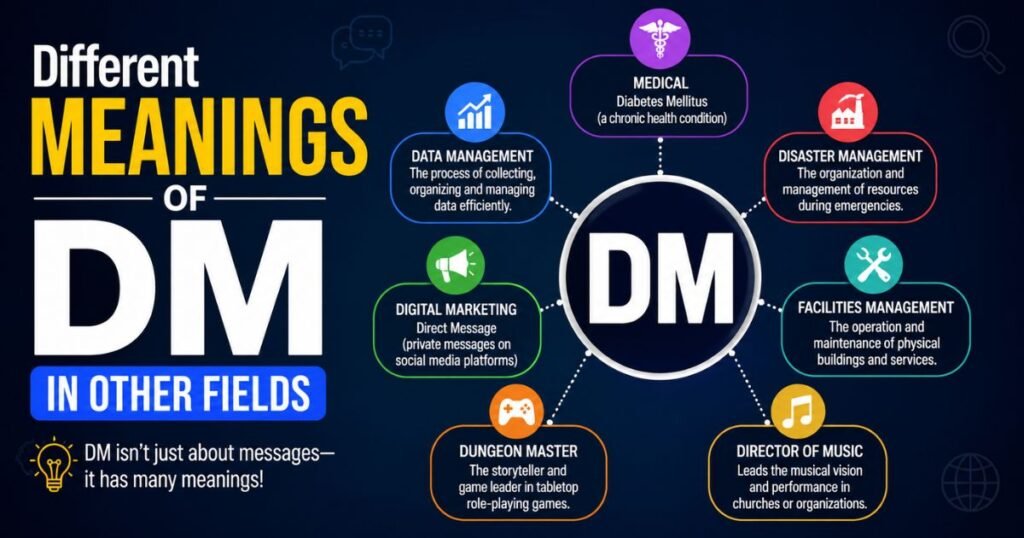
DM does not only mean Direct Message. In other industries and contexts, the same three letters can mean something completely different.
Some other meanings of DM include:
- Dungeon Master – used in tabletop games like Dungeons & Dragons, referring to the person who runs the game
- Diabetes Mellitus – a medical term used by doctors and healthcare workers
- Direct Marketing – a business term for advertising sent straight to customers
- Deutsche Mark – the former currency of Germany before the Euro
- District Magistrate – a government position used in some countries like India and Pakistan
Because of these different meanings, it is important to look at the context. If someone is talking about gaming, DM likely means Dungeon Master. If someone is chatting on social media, DM almost always means Direct Message.
Common Confusions, Mistakes & Wrong Interpretations
Many people, especially those new to social media, mix up DM with other similar terms. This can lead to small misunderstandings in conversations.
Here are a few common mistakes:
- Confusing DM with a group chat message, even though DM usually means private and one-on-one
- Thinking DM only works on Instagram, when it actually works on almost every app
- Believing DM messages are fully private and safe from screenshots, which is not always true
- Mixing up DM with PM, even though they mean almost the same thing today
Another common mistake is assuming a DM request always means something romantic or personal. In reality, DMs are used for business, customer service, job offers, and everyday friendly chats too.
Similar Terms, Alternatives & Related Slang
Several other terms are closely related to DM, and people often use them interchangeably.
| Term | Meaning |
| PM | Private Message, an older term with the same meaning |
| Inbox | Often used as a verb, like “inbox me” |
| Slide in | Sending a DM, usually to start a new conversation |
| Text me | Asking for a message through SMS instead of social media |
| Chat privately | A more formal way to describe DMing someone |
While these terms are similar, DM remains the most widely used and recognized word across social media today. It feels more modern and casual compared to older terms like PM.
Examples of DM in Real Chat Situations
Seeing DM used in real examples makes it easier to understand. Here are some everyday situations where DM comes up naturally.
Example 1: Business Inquiry “Interested in the product? DM us for pricing.”
Example 2: Friendly Chat “That was such a funny post. DM me the full story!”
Example 3: Social Media Comment “Loved your artwork. DMing you now about a possible collab.”
Example 4: Customer Support “We’re sorry for the trouble. Please DM us your order number so we can help.”
These examples show that DM fits naturally into both personal and professional conversations. It works well whether the tone is casual or formal.
How to Reply When Someone Says DM
When someone asks you to DM them, the reply is usually simple. You just need to open their profile and send a private message through the app’s messaging feature.
Steps to follow:
- Go to the person’s profile or chat icon
- Tap the message or DM button
- Type your message clearly and politely
- Send it and wait for their reply
If you are unsure what to say, keep it short and clear. Mention why you are messaging, especially if it is the first time you are contacting that person. A polite and direct message usually gets a faster response.
Also Read This:CLFS Meaning in Text
Is DM Still Popular? Trends & Online Usage
Yes, DM is still one of the most used terms in online communication today. In fact, its usage has grown as more brands and creators rely on private messaging for sales, support, and personal connection.
Current trends show that:
- Businesses use DMs for customer service almost as much as email
- Influencers often ask followers to DM for collaborations
- Dating and networking often start with a simple DM
- Automated DM replies are becoming common for brands with large followings
Because private messaging keeps growing across every platform, DM is expected to remain a common term for many years ahead. It is simple, short, and easy for everyone to understand.
DM Meaning in Text WhatsApp
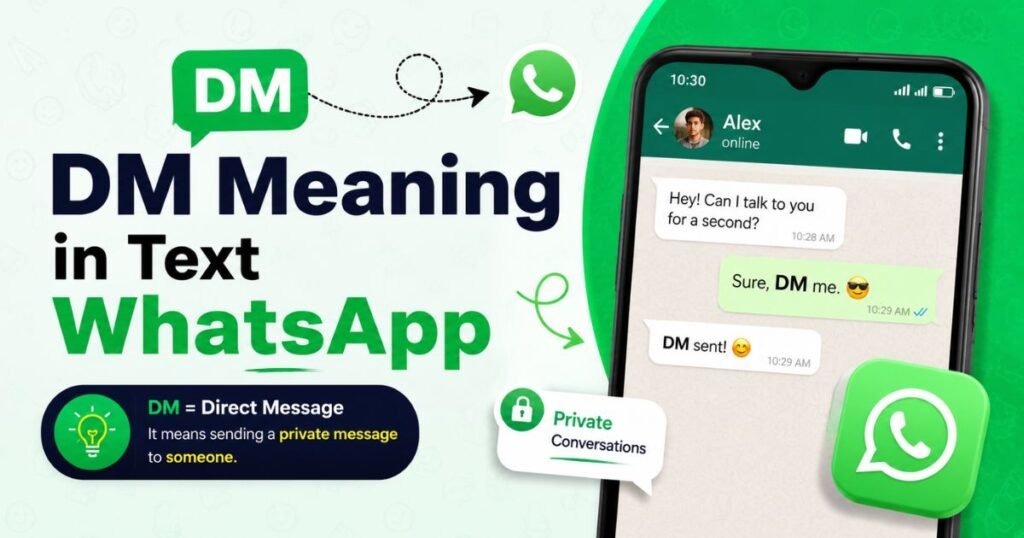
On WhatsApp, most chats are already private by default, since the app is built around one-on-one and small group messaging. Because of this, people do not use the term DM as often here compared to Instagram or Twitter.
However, when someone does say DM on WhatsApp, it usually means they want to move a conversation from a group chat into a personal one-on-one chat. For example, if a business is added to a large WhatsApp group, a member might say, “DM me the details,” meaning they want a private conversation instead of a public one in the group.
DM Meaning in WhatsApp Chat
Inside a WhatsApp chat, DM simply confirms that the message is meant only for the two people involved. Since WhatsApp does not have a separate “public” and “private” messaging system like Instagram, the term is mostly borrowed from other platforms.
Some WhatsApp users also use DM when referring to messages sent through WhatsApp Business, especially when a customer reaches out privately instead of commenting on a linked social media post. In this case, DM helps separate a personal customer chat from public reviews or comments elsewhere.
DM Means in Instagram
On Instagram, DM has a very specific and important meaning. It refers to Instagram Direct, the app’s built-in private messaging system. This is where users send text messages, photos, videos, voice notes, and even shared posts privately.
Instagram DMs are extremely popular for:
- Personal conversations between friends and family
- Business inquiries and customer support
- Collaboration requests between creators and brands
- Sharing posts, reels, or stories privately
Since Instagram is a highly visual and public platform, DMs give users a way to have real, private conversations away from public comments and likes.
DM Meaning in Text From a Guy
When a guy sends “DM me” or “I’ll DM you,” it usually means he wants to continue the conversation privately. This can happen for several reasons, and the meaning often depends on the context of the conversation.
Common reasons a guy might ask to DM include:
- Wanting to talk more personally, away from public comments
- Asking for contact details like a phone number
- Continuing a conversation that started on a public post
- Showing romantic or friendly interest in getting to know someone better
It is important to read the full context of the conversation. A DM request from a guy is not always romantic. Sometimes it is simply about business, networking, or casual friendly chat.
Final Thoughts
DM is a small term with a big role in how people talk online today. Whether it is used on Instagram, WhatsApp, TikTok, or even outside social media in gaming and medical fields, the meaning changes only slightly depending on where you see it. Once you understand the context, using and understanding DM becomes second nature.
At its core, DM is simply about privacy and direct connection. It helps people move conversations away from public spaces and into a space that feels more personal. As social media continues to grow, DM will likely remain one of the most useful and common short forms in everyday digital communication.