
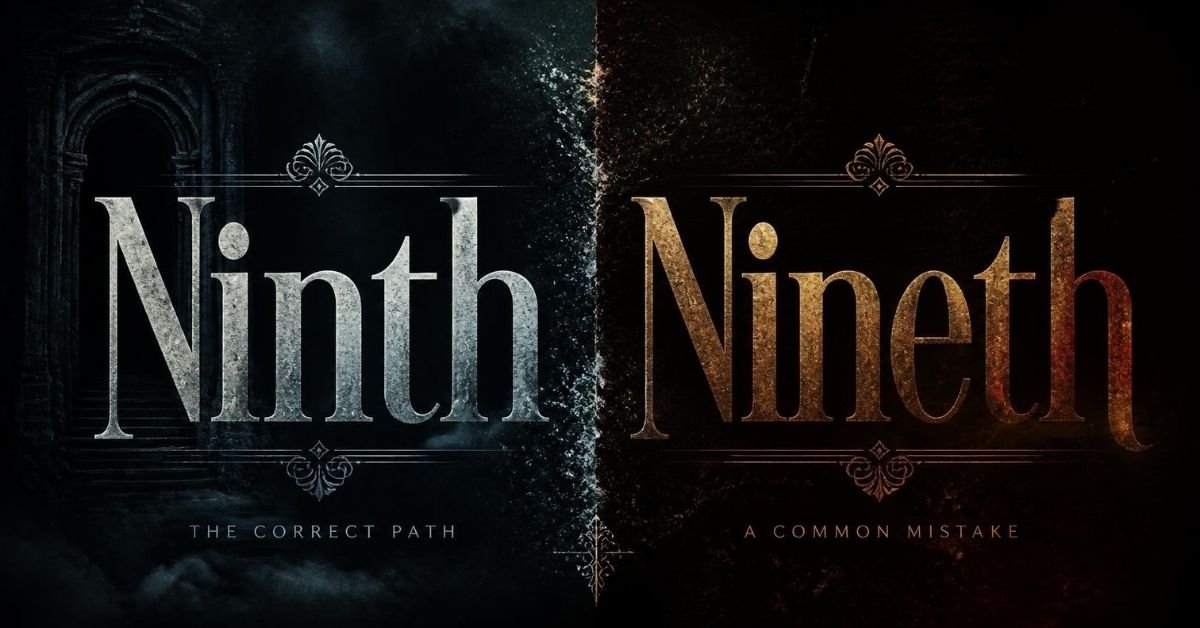

Ever typed “the nineth of June” and felt something looked off? You’re not alone, and that tiny pause is why thousands of people search this question.
The answer is short: ninth is the correct spelling. Nineth is an incorrect spelling, and no major dictionary accepts it.
Nineth or Ninth – Quick Answer
Use ninth. Every trusted dictionary form, including the Cambridge Dictionary, lists it as the accepted form.
The version with the extra “e” is a plain spelling mistake.
Here’s the logic in one breath. Take the base number nine, drop the “e”, and add “th”.
That gives you ninth, with no leftover letter hanging around.
You’ve seen the same move before. Five becomes fifth, and eight becomes eighth.
So ninth isn’t a weird exception. It fits a pattern you already use without thinking.
The Origin of Nineth or Ninth
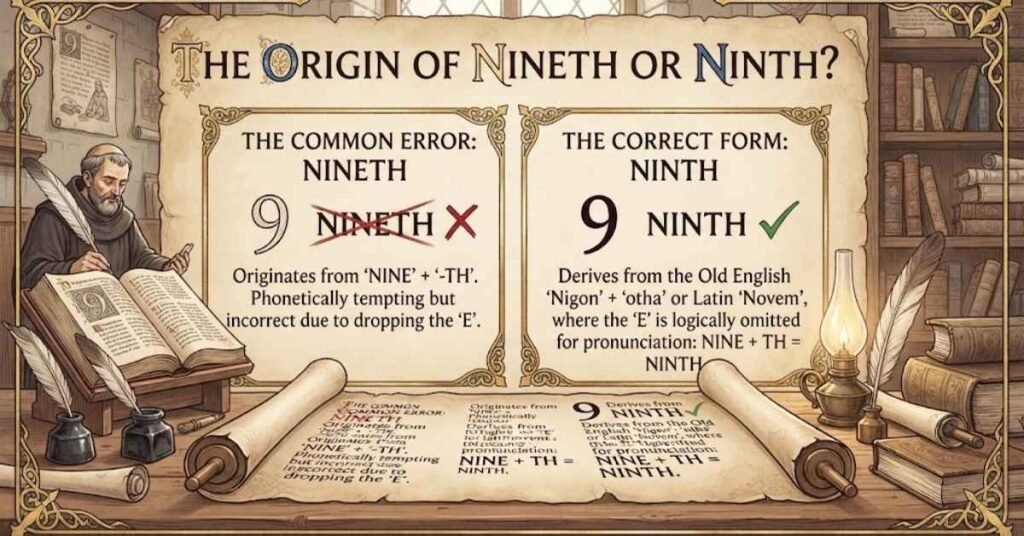
Words have baggage, and this one’s no different. The etymology goes back to Old English, where the form looked closer to nigotha.
Over centuries, speakers trimmed and reshaped it until we landed on today’s modern spelling.
Why does that matter to you? Because historical spelling was messy.
Before printing presses and dictionaries, people wrote words however they sounded, so you’d find many odd versions of the same number.
Then standardization stepped in. Printers and dictionary makers settled on one ordinal form.
Nineth never made the cut, which is why it looks like a typo to modern eyes.
British English vs American English Spelling
Here’s a relief: there’s no split on this one. British English and American English both write ninth.
You won’t find a regional twist like “colour” versus “color” here.
That holds across UK English, US English, and Commonwealth English. It also holds for Global English, the kind you read online every day.
So you don’t need to pick a side before you type.
People often assume otherwise because other words do change by region. That assumption is where the word confusion starts.
The table below clears it up fast.
Comparison Table
| Variety of English | Correct spelling | Is “nineth” accepted? |
| British English | ninth | No |
| American English | ninth | No |
| Commonwealth English | ninth | No |
| Global English | ninth | No |
Which Spelling Should You Use?
Always pick ninth. That goes for formal writing, informal writing, and everything in between.
A cover letter, a text to a friend, and a school essay all want the same word.
Think about professional communication for a second. A single misspelling in an email can make a reader doubt the rest.
It’s unfair, sure, but people judge writing accuracy quickly.
The good news is that this fix is tiny. You only need one simple rule to get it right every time.
Once it sticks, you’ll never second guess correct usage again.
Common Mistakes with Nineth or Ninth
Most errors come from sound, not carelessness. When you say the word aloud, the “n” in nine feels like it should stay whole.
That’s classic pronunciation confusion, and it explains why the common spelling error survives.
Another trap is the word “nineteenth”. It keeps its “e” because nineteen ends in “n” plus “teen”.
Some writers copy that pattern and wrongly carry the “e” into ninth.
Here are the slips you’ll see most often:
- Writing nineth because the base word nine “looks” complete
- Mixing up ninth with “nineteenth” or “ninetieth”
- Trusting a memory of how the word sounds, not how it’s built
- Ignoring a red underline from spellcheck
- Typing fast on phones and skipping a second look
Notice a theme? None of these mean you’re bad at English grammar.
They mean your brain took a shortcut, and shortcuts need a quick check.
Nineth or Ninth in Everyday Examples
Let’s put the word to work. Picture a ninth birthday party where the card says “Happy 9th”. When you spell it out, you write ninth.
That tiny choice keeps the card clean and the grandparents happy.
Now think about a street address or house number. You might live on Ninth Avenue, or your office might sit on the ninth floor.
On online forms, a typo here can send a delivery to the wrong door.
Here are more usage examples you can borrow:
- She finished in ninth place at the regional math contest.
- The ninth anniversary dinner felt calmer than the first.
- Our team ranking slipped to ninth position this season.
- Open your book to the ninth chapter before class.
- He starts ninth grade next month.
See how natural they sound? Each one works for school work, emails, and dates alike.
Even social posts and comments look sharper when the spelling is right.
Nineth or Ninth – Google Trends & Usage Data
Search habits tell a quiet story. When you check Google Trends, you’ll see people typing both versions side by side.
That pairing shows real search intent: they aren’t sure, so they ask.
Exact search volume shifts over time, so I won’t quote numbers that could go stale. Open Google Trends yourself and compare “nineth” against “ninth” for your country.
It takes under a minute, and it’s a neat way to read usage data firsthand.
You’ll likely notice interest in the question from regions like South Asia, Southeast Asia, and the Middle East. Many students learning English live there, and they’re often checking spelling rules before English exams.
That’s a great reason to treat this topic as a real grammar guide need, not a trivial one.
Comparison Table: Nineth vs Ninth
| Feature | Ninth | Nineth |
| Status | Correct | Incorrect |
| In dictionaries | Yes | No |
| Works in exams | Yes | No, loses marks |
| Works in emails | Yes | No, looks careless |
| How it forms | Nine, drop “e”, add “th” | Nine plus “th” (wrong) |
| Accepted in UK and US | Yes | No |
A Simple Rule You Can Remember
Want a memorization tip that actually works? Say this: “Nine loses its tail before the ‘th’ arrives.”
The “e” is the tail, and it drops off.
You can also lean on the pattern you already trust. If fifth looks right to you, then ninth follows the same word formation.
Both change the base word a little before the suffix “-th” joins in.
Try writing the three words together: fifth, eighth, ninth. Then cover them and write them again from memory.
That quick drill is real proofreading practice, and it takes about thirty seconds.
Other Number Words That Trip People Up
Ninth isn’t the only ordinal spelling that causes trouble. “Twelfth” loses the “ve” from twelve, and “fifth” swaps “ve” for “f”.
These quirks are why number spelling feels trickier than it should.
Here’s a quick cheat sheet of number transformation examples:
- Five → Fifth
- Eight → Eighth
- Nine → Ninth
- Twelve → Twelfth
- Forty → Fortieth
Spot the odd ones out? Nine and twelve both lose a letter, while forty changes its ending.
Knowing the pattern beats memorizing each word one by one.
Why Spellcheck Sometimes Lets You Down
Most tools catch nineth, but not always. Mobile spellcheck can autocorrect when you type fast, yet it may stay quiet inside a name, a code, or a hashtag.
So don’t hand your writing skills over to a robot completely.
Here’s a small story. Imagine a student typing a quick note to a teacher on a phone, rushing before class.
The autocorrect flips “ninth” to “nineth”, and nobody notices until the grade comes back.
The fix is easy. Read your message once before you hit send, especially when it holds dates or ranks.
That habit supports clear writing and saves you from small, avoidable error correction later.
Tips for Students Learning English
If you’re learning the language, this word is a friendly place to start. It teaches you how ordinal numbers differ from a cardinal number like nine.
A cardinal number counts, while an ordinal tells you the position.
Build a tiny routine around English spelling rules. Write the cardinal, write its ordinal, and say both out loud.
This builds English vocabulary and trains your eye to spot word confusion early.
Reading helps too. Books, articles, and news writing all show standard English in action.
The more you see ninth spelled right, the less you’ll doubt it.
Conclusion
The verdict is clear: ninth is right and nineth is wrong. Drop the “e” from nine, add “th”, and you’re done. Keep that simple rule close, and your writing accuracy will thank you.This small fix carries weight. It shows care in emails, exams, addresses, and everyday posts.
Good habits like this build professional English one word at a time.Now it’s your turn. Did ninth ever trip you up, or do you know a tricky word that does? Drop a comment, and share this with a friend who’s still typing “nineth”.
FAQs
Is it nineth or ninth?
It’s ninth. Nineth is a common spelling error and isn’t listed as a valid word.
Is “nineth” ever correct in British English?
No. British English uses ninth, just like American English does. No regional version accepts the extra “e”.
Why does ninth drop the “e”?
The base word nine loses its silent “e” when the suffix “-th” attaches. Five and eight follow similar shortcuts in their ordinal form.
How do you spell the number 9 as an ordinal?
You write it as ninth, or as 9th in numerals. Both are standard, and both count as proper usage.
Can I use “9th” instead of “ninth”?
Yes, in most cases. Use the spelled out ninth in formal writing and the short 9th in tables, dates, or tight spaces.
Is “nineteenth” spelled with an “e”?
Yes. Nineteenth keeps the “e” because it builds on nineteen, not nine. This is a big reason people mix things up.
What’s the quickest way to avoid this mistake?
Remember that nine loses its tail before the “th”. A quick pass of proofreading before you publish or send also helps.
Where can I double check the spelling?
Look it up in a trusted dictionary such as the Cambridge Dictionary. It confirms ninth as the standard usage in seconds.