

Absence is the correct spelling. Absense is a spelling mistake that no dictionary recognizes. That’s the whole answer, but the reason behind it will help you never second-guess it again.Ever stared at a word until it looked wrong? You type “absence,” pause, and wonder if it should end like “sense.” You’re not alone, and your instinct isn’t silly.
Stick around for a few minutes. You’ll learn where the word comes from, why people mix it up, and how to lock the right spelling into your head. Plus, you’ll get quick proofreading tips you can use in emails, school essays, and office reports today.
Absence or Absense – Quick Answer
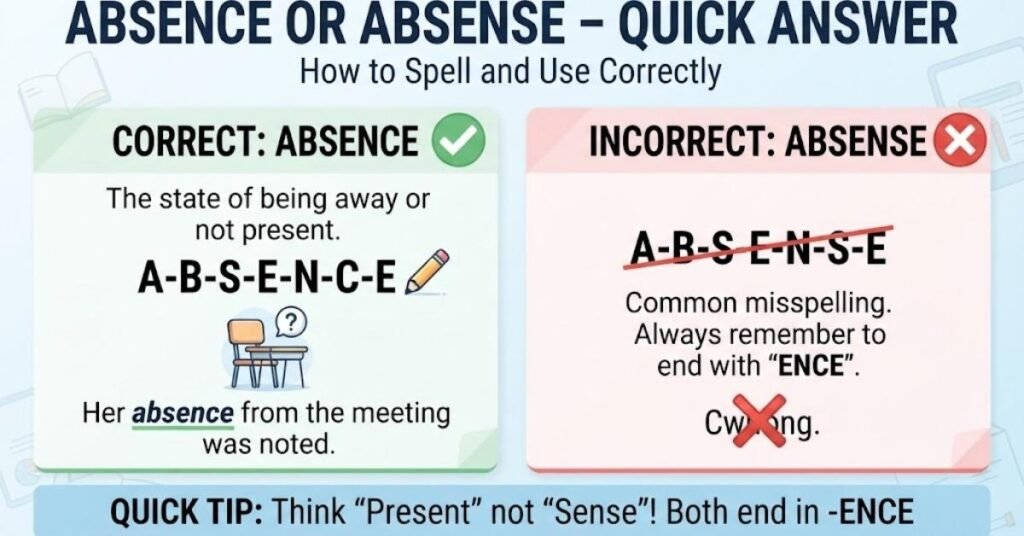
The correct form is absence, spelled A-B-S-E-N-C-E.
It ends with -ence, just like presence, difference, silence, and patience.
Absense is a misspelling. You won’t find it in Merriam-Webster or any other trusted dictionary.
If you use it in formal writing, readers will notice, and they might judge your credibility.
So when you wonder how do you spell absence, remember one thing.
The word has no “sense” in it, even though it sounds like it might.
Absence Meaning
Absence is a noun. It describes the state of being away or not present.
Think of a student who skips class or a manager who misses a meeting.
It also works for things, not just people.
The absence of rain can ruin a harvest, and the absence of evidence can stall a court case.
The absence meaning stretches a bit further, too.
It can describe a lack of something, like an absence of fear or an absence of rules.
The Origin of Absence or Absense

Every word origin has a story, and this one is short and tidy.
Absence comes from the Latin word absentia, which means “a being away.”
That Latin origin traveled through the French language before it landed in English.
The French form shaped the -ence ending we use now, and it stuck for centuries.
This etymology tells you something useful.
The historical root has no “sense” anywhere in it, so absense has no ancestor to defend it.
British English vs American English Spelling
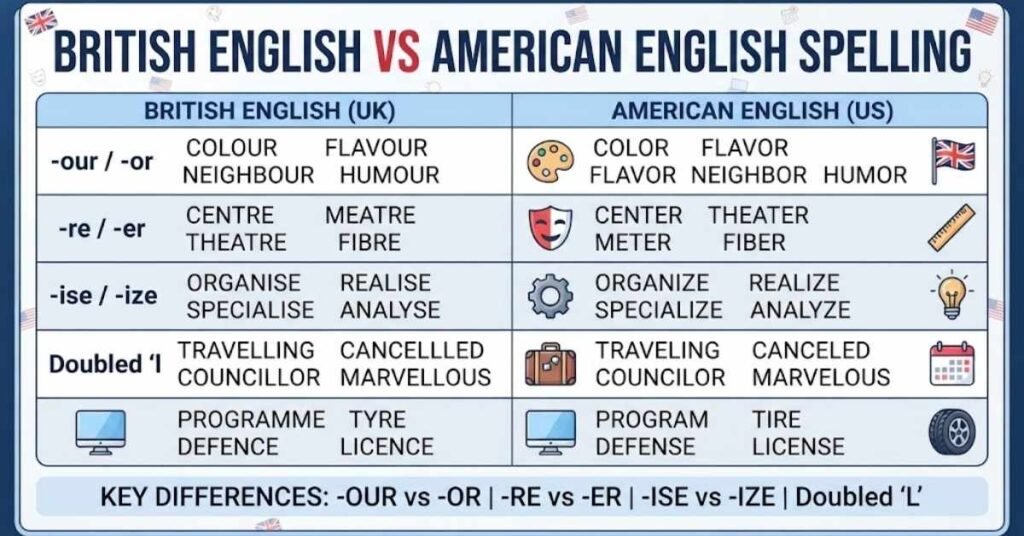
Here’s some good news. British English and American English agree on this one.
Both spell it absence, with no exceptions.
Many regional variation headaches do exist, of course.
Think of colour vs color or centre vs center, where your audience really does change the spelling.
Not this time, though.
Whether you write for a US audience, a UK audience, or readers across Commonwealth English regions, absence wins everywhere.
Which Spelling Should You Use?
Always use absence. You never need to weigh options here.
There’s no accepted spelling that includes the “s” in the final syllable.
The same goes for the plural form, which is absences.
You’d write “three absences this term,” never “three absenses.”
Want a quick check before you hit send?
Ask yourself if the word has a cousin ending in -ent. It does, because absent is the matching adjective, so the noun takes -ence.
Why Is This Mistake So Common?
Blame pronunciation. Most people say “AB-sunss,” and that last syllable sounds a lot like “sense.”
Your brain connects sounds to letters, so it reaches for the -sense ending you already know from words like nonsense and commonsense.
There’s also a sneaky bit of pronunciation confusion with the letter C.
It sounds like an S here, so the “c” acts almost like one of those silent letters, hiding in plain sight.
Add the -ence and -ance mess to the pile.
English has dozens of pairs like this, so commonly confused words pop up all the time, and a few even count as homophone confusion.
Common Mistakes with absense vs absence
Most errors come in a handful of flavors.
Spotting them helps you catch your own typing mistakes faster.
- absense instead of absence, the classic spelling error
- absance, swapping the E for an A
- absents, mixing up the noun with the adjective absent
- abscence, adding a stray C in the middle
- absence used where absent fits, like “he was absence today”
One real example shows how this plays out.
A friend of mine once sent a leave request to her boss saying “my absense on Friday.” Her boss replied with a polite “no problem,” but she cringed for a week.
Small slips like that don’t ruin careers.
Still, they chip at your professionalism, especially in business writing and academic writing where accurate writing matters.
Absence or Absense in Everyday Examples
Seeing the word in real sentences makes it stick.
Here are a few that cover common situations:
- Work: “Her absence from work lasted two days because of illness.”
- Meeting: “The team noted his absence from the meeting in the minutes.”
- School: “The teacher marked each absence in the register.”
- Weather: “The absence of rain left the fields dry.”
- Law: “The absence of evidence doesn’t prove innocence.”
- Social media: “Sorry for my absence lately, folks. I’m back!”
Notice how each sentence uses absence as a noun.
It follows words like “the,” “his,” or “her,” which is a handy clue.
You’ll also spot it in news writing, school notes, and formal documents.
Casual posts and casual writing use it the same way, with the same spelling.
Absence or Absense – Google Trends & Usage Data
Let’s talk about search behavior, because it says a lot about how people struggle with this word.
When people type search queries like “absense” or “is absense wrong,” they’re usually double-checking a spelling they feel unsure about.
Google Trends is a free tool that lets you compare terms over time.
Try typing in absence and absense side by side, and you’ll see the correct spelling dominate by a huge margin.
I won’t invent exact numbers here, since they shift constantly.
What stays steady is the pattern: worldwide usage of absence dwarfs the misspelling, and the wrong version shows up mostly as a quick “am I right?” check.
Absence vs Absense: Comparison Table
Sometimes a table says it faster than a paragraph.
Here’s the full picture in one glance.
| Feature | Absence | Absense |
| Correct spelling? | Yes | No |
| In dictionaries? | Yes, including Merriam-Webster | No |
| Word class | Noun | None |
| Plural form | Absences | Not applicable |
| Origin | Latin absentia via French | None |
| UK and US use | Both accept it | Neither accepts it |
| Safe for formal writing? | Yes | Never |
The table makes one thing obvious.
Only one of these words belongs in your writing.
How to Remember the Right Spelling
A memory trick beats memorizing a rule every time.
Here’s a simple one: absence is the opposite of presence, and both end in -ence.
Another handy method uses the adjective.
If you can say absent, the noun ends in -ence, and you can mirror the presence and present pair.
Want a third option?
Picture a presence mnemonic like this: “The absent kid left an absence, and there’s no sense in it.” Silly, yes, but it works.
Proofreading Tips and Spellcheck Limits
Don’t rely on spellcheck alone. It catches absense most of the time, but autocorrect can swap it for a wrong word.
Typos like “absent” for “absence” slide right through because both are real words.
Build a small writing habit to protect yourself.
Read your draft out loud, scan for -ence words, and check any word that makes you hesitate.
These proofreading skills take minutes and save you embarrassment.
Good proofreading practice also supports spelling consistency, which readers trust more than flashy vocabulary.
Why Correct Spelling Matters in Professional Writing
Readers judge fast, and they judge quietly.
A single spelling mistake in a cover letter, report, or office communication can shift how people see your care and clarity.
This matters across many settings.
Think school essays, exams, formal documents, and professional communication with clients.
Clean writing accuracy builds confidence in writing, too.
When you trust your spelling, you can focus on ideas, which boosts your productivity and sharpens your communication.
Tips for English Learners
If English isn’t your first language, this word may feel extra tricky.
That’s normal, because English spelling follows spelling rules that have plenty of exceptions.
Start by grouping words by their endings.
Make one list for -ence words like absence, presence, and difference, and another for -sense words like nonsense.
Practice with short usage examples each day.
This kind of language learning habit builds your English vocabulary faster than cramming a grammar reference once a month.
Conclusion
Here’s the takeaway. Absence is the correct word, and absense is a wrong spelling you can drop for good.
It comes from Latin, passed through French, and it follows the -ence ending pattern.
Use the memory trick, run a quick proofreading pass, and trust the dictionary over your ears.
That’s all it takes to keep your writing sharp, whether it’s an email, an essay, or a post.
Which commonly confused words trip you up the most? Drop your answer in the comments, because your pick might become the next guide.
And if this helped, share it with a friend who’s still typing “absense.”
FAQs
Is absense a real word?
No, absense isn’t a real word. It’s a common misspelling of absence.
How do you spell absence correctly?
The correct spelling is A-B-S-E-N-C-E. It ends with -ence, not -sense.
Is absence spelled differently in British and American English?
No, both spell it absence. This word doesn’t change between regions.
What’s the plural of absence?
The plural form is absences. For example, “She had two absences this month.”
What’s the difference between absence and absent?
Absence is a noun that names the state of being away. Absent is an adjective that describes someone who isn’t there.
What’s an easy way to remember the spelling?
Pair it with presence. Both end in -ence, and both have the matching adjectives present and absent.
Should I trust spellcheck for this word?
Mostly, yes, but not fully. Spellcheck can miss a swap like absent for absence, so a quick read-through still helps.