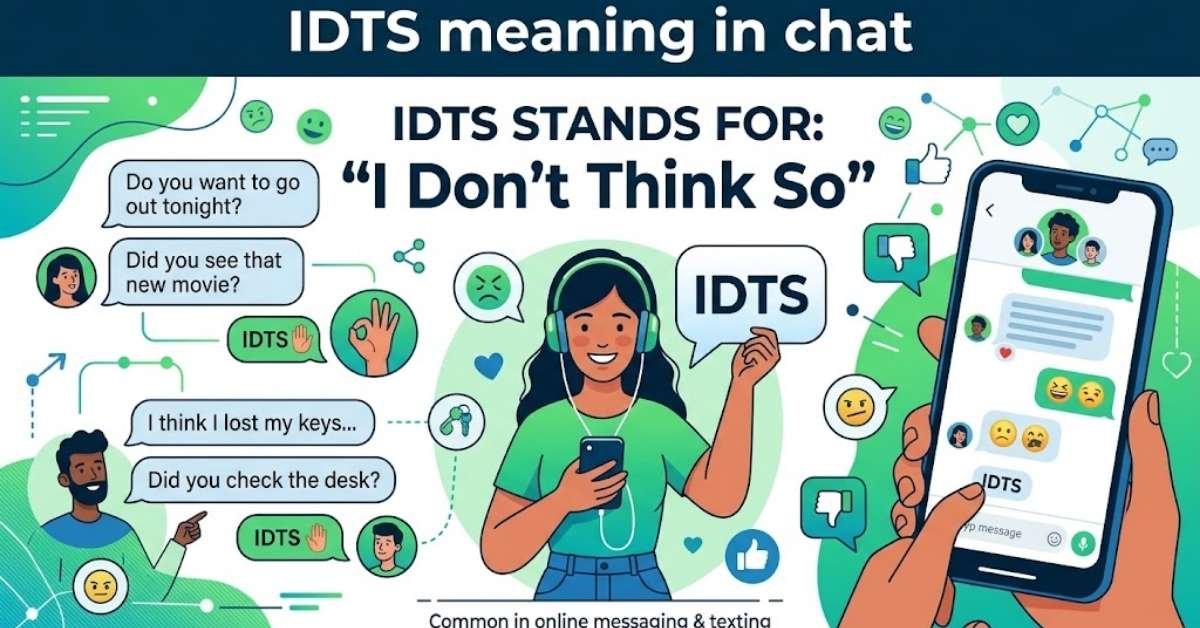

IDTS meaning in chat is simple. It stands for “I Don’t Think So.” People use this chat abbreviation to say no, or to show doubt, without typing a full sentence.Ever got an “idts” reply and wondered if it was a brush-off.
Or maybe you want to use it but worry it sounds rude. Stick around. You’ll learn what it means, where it fits, and how to reply without any awkwardness.
IDTS Meaning in Chat: Quick Definition
IDTS is a texting abbreviation for “I Don’t Think So.” It’s a quick, soft way to say no or voice doubt.
Most people type it in lowercase, and it usually sounds relaxed.
You’ll spot IDTS meaning in text threads, Instagram DM chats, and TikTok comments. It’s one of those text slang shortcuts that saves a few seconds.
Nobody needs a slang dictionary to get the gist once they’ve seen it twice.
Simple breakdown:
Here’s how the IDTS acronym splits up. Each letter stands for one word.
- I stands for “I”
- D stands for “Don’t”
- T stands for “Think”
- S stands for “So”
Put together, it reads as a mild “probably not.” It leaves a little room for the other person to be right.
Example sentences:
These chat examples show the range. Notice how the message tone shifts each time.
- “Are you coming tonight?” “idts, I’m exhausted.”
- “Will it rain tomorrow?” “idts, the sky looks clear.”
- “Is he really that fast?” “idts lol.”
Same three letters, three different moods. Context does the heavy lifting.
Origin & Background
Nobody can point to a single inventor of IDTS. Like most internet slang, it grew out of early SMS culture, where every character counted.
Phones capped messages at 160 characters, so people trimmed words wherever they could.
Those limits pushed everyone toward short forms like IDK and IMO. IDTS followed the same pattern as a natural cousin.
It simply swapped “know” for “think so,” and the habit stuck.
Today it lives mostly on messaging apps and social platforms. It isn’t as famous as LOL or BRB, but it shows language evolution in real time.
Every year, texters invent new shortcuts, and a few of them survive.
Real-Life Conversations (How People Actually Use It)
Theory is nice, but real chats teach more. Here’s how people use IDTS in online chat every day.
Notice that the tone changes with the platform.
A group chat sounds different from a private reply. Keep that in mind as you read these four scenes.
Each one comes from the kind of online conversations you probably have already.
1. WhatsApp Chat
Priya asks her cousin, “Can you cover dinner on Friday?” He replies, “idts, rent’s due that week.”
That’s IDTS in WhatsApp at its best.
It’s honest, quick, and it comes with a reason. Priya doesn’t feel rejected, just informed.
A short reason after the abbreviation makes all the difference.
2. Instagram DM
A friend sends you a reel and asks, “Is this the best pizza in town?” You reply, “idts, but it’s close.”
IDTS on Instagram often keeps playful teasing alive.
It rarely ends the chat. Usually it sparks a fun back-and-forth about where the real best slice lives.
Add a pizza emoji and the whole emoji communication thing gets even friendlier.
3. TikTok Comments
Someone comments, “This hack saves ten minutes.” Another user answers, “idts, I tried it.”
IDTS on TikTok works as a mini disagreement.
Short comment replies like this keep social media comments moving fast. Nobody writes an essay under a ten-second video.
That speed is exactly why the abbreviation thrives there.
4. Text Message
Your sister texts, “Think Dad will like this gift?” You send back, “idts, he hates scarves.”
IDTS in texting feels more personal in a text message.
It sounds like an honest opinion from someone who knows him well. That trust makes the blunt tone land softly.
With strangers, the same words might feel sharper.
Emotional & Psychological Meaning
Three letters can carry real emotional expression. Whether they land soft or sharp depends on the sender’s mood.
In texting psychology, short replies often signal speed, not anger.
Still, a flat “idts” with no emoji can feel cold. Without a voice or a face, readers fill in the blanks themselves.
That’s where most communication psychology trouble starts.
What it often signals:
Here’s what people usually mean when they send it.
- Doubt or mild uncertainty
- A soft rejection without drama
- A polite refusal when “no” feels too harsh
- A touch of emotional distance when the tone is flat
- Playful teasing when paired with emojis
Reading the message context matters more than reading the letters. Check the emojis, the timing, and who’s talking.
Usage in Different Contexts
IDTS shifts shape depending on where you type it. A casual conversation with friends is nothing like an email to your manager.
Let’s walk through four common settings.
Keep your communication style in mind each time. The same message can win a laugh in one place and raise eyebrows in another.
1. Social Media
On social media slang threads, IDTS fits right in. It’s fast, and nobody blinks.
You’ll see it under memes, reels, and hot takes.
On Twitter (X) and online forums, it often adds a mild counterpoint. You can use it without starting a fight.
Still, a quick reason keeps strangers from getting defensive.
2. Friends & Relationships
With friends, IDTS sounds relaxed and honest. Add an emoji and it turns warm.
It works well in a friends chat where everyone knows your humor.
In relationship texting, though, handle it carefully. A bare “idts” to a partner’s heartfelt idea can sting.
Try “idts, but tell me more” instead.
3. Work or Professional Settings
In workplace communication, skip it unless your team already uses slang. Write “I don’t think so” in full.
That small change reads as professional communication.
It also protects your digital etiquette in formal writing. Think of it like wearing a tie to a client meeting.
You may never need it, but it never hurts.
4. Casual vs Serious Tone
Use IDTS when stakes are low. Planning pizza toppings? Perfect.
It keeps the conversational tone light and quick.
Drop it for any serious conversation. Health, money, and grief deserve full sentences.
Slow down, and your reader will notice the care.
Common Misunderstandings
Because it’s short, people misread it often. Let’s clear up the biggest traps.
Each one comes from missing a little context.
Remember, context matters more than the abbreviation itself. A quick glance at the situation solves most confusion.
1. Thinking It Means “I Don’t Know”
Many readers confuse IDTS with IDK. They look alike, but they say different things.
IDK admits you lack an answer.
IDTS gives an answer, and it leans toward no. That’s a big gap in abbreviation meaning.
Mix them up, and you might promise something you never meant to.
2. Assuming It’s Always Rude
Not at all. Most senders just want a quick casual response.
Plenty of people use it as a blunt response without any bad feeling.
Rudeness comes from tone, timing, and context. The letters themselves stay neutral.
Judge the sender, not the shortcut.
3. Using It in Sensitive Situations
Imagine a friend shares a big dream with you. Replying “idts” would crush the moment.
Speed isn’t the goal here.
In sensitive talks, emotional support beats shorthand. Choose warmer words and explain your reasoning.
That’s respectful communication in action.
4. Misreading Tone
Text strips out voice, face, and pace. That’s why tone misunderstanding happens so often.
Even a calm “idts” can read as cold.
When you’re unsure, ask a quick follow-up. “Did you mean that as a joke?” clears the air fast.
Better a short question than a long argument.
Comparison Table
A quick table helps when abbreviations blur together. This one compares IDTS with its closest cousins.
Think of it as a cheat sheet for texting vocabulary.
| Abbreviation | Full Form | Meaning | Usual Tone |
| IDTS | I Don’t Think So | Soft no or doubt | Casual, mild |
| IDK | I Don’t Know | No answer available | Neutral |
| IMO | In My Opinion | Sharing a view | Polite |
| TBH | To Be Honest | Honest take ahead | Direct |
| Nope | No | Firm refusal | Blunt |
| Maybe not | Maybe not | Gentle doubt | Soft |
Notice that IDTS sits between “nope” and “maybe not.” It’s firm enough to mean no, yet gentle enough to avoid conflict.
That middle spot explains why people like it.
Variations / Types of IDTS
People tweak IDTS to match their mood. These versions pop up across chat language.
- idts lol: playful, light disagreement
- idts tbh: honest and direct
- idts bro: friendly and very casual
- idts, sorry: a polite refusal
- IDTS in caps: stronger emphasis
- idts rn: not at this moment
Each tag shifts the tone. Pick the one that matches what you actually feel.
How to Respond When Someone Uses IDTS
Got an “idts” in your inbox? Don’t panic, because you have plenty of reply ideas.
Match your answer to the relationship and the mood.
Here are four styles that work. They cover most chat responses you’ll ever need.
Casual Replies
Keep it light when the chat is relaxed.
- “Fair enough, maybe next time.”
- “Okay, your call.”
- “Got it, no stress.”
These casual replies keep the conversation flow smooth. Nobody feels pushed.
Funny Replies
- “Ouch, my feelings just filed a complaint.”
- “idts? Bold of you.”
- “Wow, tell me how you really feel.”
Funny replies work only with people who share your humor. Skip them if the vibe feels tense.
Mature / Confident Replies
Stay calm and ask why. Try this: “Fair point. What makes you doubt it?”
This shows emotional intelligence and confidence.
It invites direct communication without drama. You get the real reason, and the other person feels heard.
That’s a win for both sides.
Private / Respectful Replies
If the message hurt, move the talk to a private space. Send something like, “Can we chat about that later?”
Respectful replies protect feelings on both sides.
They also keep group chat peace. Nobody enjoys watching two friends squabble in public.
A calm private message fixes more than a loud public one.
Regional & Cultural Usage
Slang travels, yet culture shapes how it lands. Cross-cultural communication needs a little patience.
Directness varies from place to place.
A blunt “idts” may feel normal in one country and sharp in another. These are general patterns, not strict rules.
Individuals always differ.
Western Culture
In many Western circles, direct communication gets respect. IDTS usually reads as honest, not harsh.
Younger users often add a joke or an emoji.
That keeps the casual texting vibe intact. It also shows you’re being friendly, not cold.
Western texting culture leans toward short and quick.
Asian Culture
In many Asian communities, softer and more indirect refusals are common. A bare IDTS can feel abrupt to some readers.
Adding “sorry” or a smiley softens it.
Many bilingual chatters mix English text slang with local words. That blend is part of everyday digital language there.
When in doubt, add a kind word.
Middle Eastern Culture
In many Middle Eastern chats, warmth and courtesy often come first. A polite rejection usually includes a friendly phrase.
Plenty of people type English abbreviations right next to Arabic.
IDTS works best when it comes wrapped in kind words. A simple “sorry, habibi, idts” feels far more natural than a lone abbreviation.
Tone beats brevity here.
Global Internet Usage
Online, borders blur. Gaming chats and online gaming lobbies spread internet abbreviations worldwide.
Memes carry them even further.
In a mixed crowd, spell it out once. Then your meaning stays clear to every reader.
That small step prevents big confusion.
Texting Etiquette: Smart Ways to Use IDTS
A few habits keep your texting etiquette sharp. Follow them and IDTS won’t cause trouble.
- Add a reason when you can
- Use an emoji for warmth
- Skip it in sensitive talks
- Spell it out for older readers
- Read the room first
These texting tips take five seconds. They save you from awkward replies later.
Why Short Forms Keep Winning
Fast communication rules modern digital conversations. Shorthand texting saves time on mobile messaging.
Nobody wants to type a paragraph while walking to the bus.
Younger users also love in-group language. Using internet vocabulary feels like belonging.
That’s why new internet trends in slang appear every single year.
Conclusion
IDTS means “I Don’t Think So,” and it’s a small, useful tool. Used well, it gives a soft rejection without any fuss. Match the tone to the person, the platform, and the moment.
When in doubt, add a kind word. It costs you nothing and saves plenty of awkwardness.Have you ever misread an “idts”? Drop your story in the comments. Share this guide with a friend who texts too fast.
FAQs
1. What does IDTS mean in texting?
IDTS meaning in texting is “I Don’t Think So.” People use it to show doubt or decline gently.
It’s short for speed, and you’ll see it in SMS texting and messaging apps.
2. Is IDTS rude?
Not by default. Tone, timing, and context decide how it lands.
A flat reply to emotional news can hurt, while a playful reply to a casual question rarely does.
3. Can I use IDTS in formal writing?
No, skip it in emails, reports, and school work. Write “I don’t think so” or “I doubt it” instead.
Formal writing expects full words, and that keeps you credible.
4. What’s the difference between IDTS and IDK?
IDK means you don’t know. IDTS means you lean toward no.
One shows uncertainty, and the other shows a mild opinion.
5. How do I make IDTS sound polite?
Add a reason, a “sorry,” or a friendly emoji. Try this: “idts, sorry, I’m booked that day.”
Soft words turn a blunt reply into polite communication, and it only takes a few extra seconds.
6. Is IDTS commonly used today?
It’s used, but less than IDK or LOL. You’ll find it in casual chats and comment threads.
Younger users and gamers tend to use it most, though it depends on your circle.
7. Can IDTS hurt someone’s feelings?
Yes, it can, especially when someone shares a dream, a plan, or a vulnerable thought.
In those moments, choose warmth and explain your view with kindness.