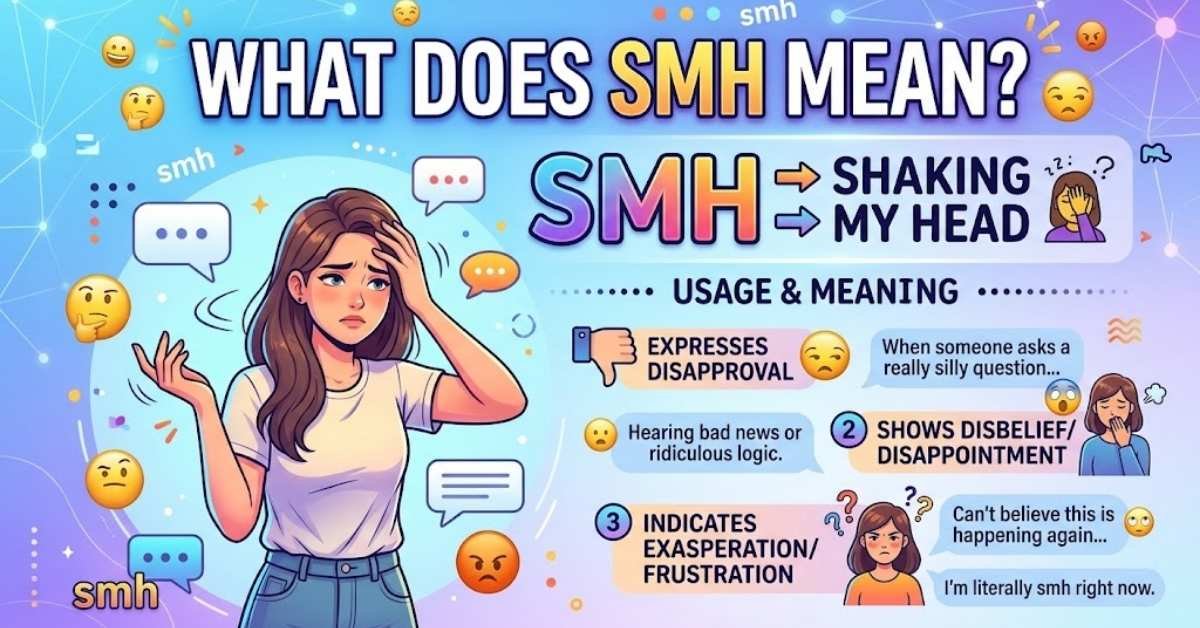

SMH means “shaking my head.” People type it to show disbelief, disappointment, or mild frustration, like a digital gesture you’d make in person.You’ve probably seen it under a social media comment and wondered if the writer was angry.
Or a friend sent it in a text message and you weren’t sure whether to reply or apologize.Short answer: it’s usually a silent reaction, not an attack. This guide shows you how to read it, use it, and answer it without awkward moments.
SMH – Quick Meaning
Think of SMH as a head shake you can type.
It’s one of the most common internet slang terms in text messaging, and it fits almost any “I can’t believe this” moment.
Simple Definition:
SMH is an acronym for shaking my head, used to show disapproval, disbelief, or tired disappointment.
It’s a chat abbreviation that replaces a sigh and a headshake.
In plain terms:
It means “wow, really?”
You aren’t yelling, you’re just letting out a quiet sigh in text form.
Quick Examples:
- “He left the oven on all day again, SMH.”
- “Third flight delay this week. SMH.”
- “She replied to the group chat with a thumbs up. SMH lol.”
Origin & Background
The SMH abbreviation grew out of early chat rooms and online forums.
Typing was slow back then, so people trimmed phrases down to a few letters.
Records of it show up in the early 2000s, and it spread fast once Twitter forced tight character limits.
By the 2010s, it had jumped to Instagram, TikTok, and nearly every messaging app.
Today it’s a staple of internet culture, and you’ll hear people say it out loud too.
That’s a good example of language evolution: a typing shortcut that became real speech.
Real-Life Conversations (How People Actually Use SMH)
Definitions help, but real-life examples teach faster.
Here’s how SMH sounds across the apps you probably use daily.
1. WhatsApp Chat
Picture a family group where an uncle forwards the same fake news story for the fifth time.
Your cousin writes, “Uncle, please check before sharing. SMH.”
That’s gentle, a little funny, and clear.
Nobody’s offended because the casual tone says “we love you, but come on.”
2. Instagram DMs
Your friend sends a screenshot of a stranger’s wild comment.
You reply, “SMH at this point,” and add a laughing emoji.
In Instagram DMs, SMH often pairs with a reaction emoji to soften it.
The emoji tells your friend you’re amused, not upset.
3. TikTok Comments
Under a video of someone parking across three spots, the top TikTok comment is “SMH people.”
Thousands of likes follow.
Here, SMH works as a shared reaction post.
It lets a crowd agree without writing a paragraph.
4. Text Message
Say you tell a friend you locked your keys in the car again.
She texts back, “SMH.”
That one word means “classic you,” usually with a smile behind it.
Tone depends on your history, which is why context clues matter.
Emotional & Psychological Meaning
SMH looks tiny, but it carries a lot of emotional expression.
It’s a form of digital body language that fills the gap where a face or voice would be.
What it usually expresses:
- Disappointment in a result or choice
- Disbelief at something absurd
- Mild disapproval or soft criticism
- Second-hand embarrassment for someone else’s mistake
- Emotional exhaustion from repeated nonsense
Why people use it:
Typing a full complaint takes effort, and it can start fights.
SMH lets you react without escalating, which many people see as good emotional intelligence.
It also saves face.
You show your opinion while keeping the conversation tone light.
Usage in Different Contexts
The same two-second SMH can read warm in one chat and cold in another.
So where you use it matters as much as what you mean.
1. Social Media
On social media, SMH is totally normal.
It fits comments, replies, and viral slang threads where speed beats polish.
2. Friends & Relationships
With friends, it’s often friendly teasing.
In romantic relationships, though, be careful, because a lone “SMH” during an argument can feel dismissive.
3. Work or Professional Settings
In workplace chats with close teammates, a quick SMH after a broken printer is fine.
In professional emails or messages to clients, skip it and write the thought out.
4. Casual vs Serious Tone
Casual tone welcomes SMH.
A serious tone, like talking about a loss or a health scare, does not.
Common Misunderstandings
Because SMH is so short, people read their own mood into it.
That’s where most internet misunderstandings start.
1. Thinking SMH is always rude
It isn’t.
Most of the time it’s humor or mild annoyance aimed at a situation, not a person.
2. Assuming it means anger
Anger usually comes with capital letters or sharp words.
SMH is quieter, closer to frustration mixed with a sigh.
3. Using it in formal communication
Formal communication needs complete sentences and a clear voice.
An acronym like SMH can look careless to a manager or a recruiter.
4. Overusing it
Type it after every message and it loses meaning.
It can also make you sound permanently negative.
When NOT to use SMH:
- When someone shares sensitive topics like illness or grief
- Right after an apology from someone
- In professional etiquette moments such as client emails
- When you’re genuinely upset and need to explain why
Comparison Table
Here’s how SMH stacks up against other popular reaction phrases.
Use it to pick the right one fast.
| Term | Meaning | Typical Feeling | Best Place to Use |
| SMH | Shaking my head | Disappointed, disbelieving | Friends, social media |
| LOL | Laughing out loud | Amused | Almost anywhere casual |
| OMG | Oh my god | Shock or excitement | Casual chats |
| WTF | What the f***, strong confusion or anger | Intense | Close friends only |
| Facepalm | Hand to face gesture | Embarrassed, exasperated | Memes, group chats |
Key Insight:
SMH sits in the middle.
It’s stronger than a shrug but softer than WTF, which makes it the safest way to show mild disapproval.
Variations / Types of SMH
People stretch SMH to match their mood.
Here are the SMH variations you’ll see most.
- SMH my head: technically redundant, since the H already means head. People still use it for emphasis.
- SMH so hard: turns the volume up on disappointment.
- SMH fr: “for real,” so the reaction is serious.
- SMH lol: disbelief with a laugh.
- SMH at this point: you’re tired of the same thing happening.
- SMH y’all or SMH bro: addressed to a group or a buddy.
- SMH again: the problem keeps repeating.
- Big SMH moment: a joke label for something truly cringe.
How to Respond When Someone Uses SMH
First, read the context clues.
Is it aimed at you or at a situation? That decides your reply.
Casual Replies
- “Yeah, I know.”
- “I’ll fix it, promise.”
- “Haha fair.”
Funny Replies
- “Don’t shake too hard, your head might fall off.”
- “SMH back at you, we’re both disasters.”
- “Noted. Adding it to my list of shame.”
Mature / Confident Replies
- “I hear you. Here’s what happened.”
- “Fair reaction. I’ll do better next time.”
- “Want me to explain?”
Respectful / Private Replies
If the SMH hits a nerve, move the talk off the group chat.
Try, “Can I call you quickly? I’d like to clear this up.”
Regional & Cultural Usage
SMH is global, but its flavor shifts by place.
Local humor and non-native English speakers change how it lands.
Western Culture
In the US, UK, and Canada, SMH is everywhere in casual chat.
It’s often sarcastic or playful, and older audiences may need it explained.
Asian Culture
Many users in Asia pick it up through Gen Z slang on TikTok and Instagram.
They often mix it with local-language phrases or emoji, creating a hybrid digital expression.
Middle Eastern Culture
In places like the UAE, Saudi Arabia, and Pakistan, SMH shows up in English-Arabic or English-Urdu chats.
It’s usually taken lightly, though people tend to avoid it with elders out of respect.
Global Internet Usage
Online, SMH has become internet vocabulary that crosses borders.
Its short form and clear emotional cue make it easy for anyone to learn.
Other Acronyms You’ll See Next to SMH
SMH rarely travels alone.
You’ll often spot it near other common internet acronyms in the same thread.
- OP: original poster, the person who started the thread
- HB: usually “happy birthday,” though some people use it for “hit back”
- LOL, OMG, WTF: the classic reaction words
If a term confuses you, check a slang dictionary or scan the replies.
Digital literacy today means reading the room as much as the letters.
Tips to Use SMH Without Sounding Rude
A few habits keep your online etiquette solid.
They’re simple, and they work.
- Add context: “SMH, this traffic” beats a bare “SMH.”
- Match the room: use it where jokes are welcome.
- Soften it: a smiley or “lol” changes the whole vibe.
- Know your reader: older relatives may take it harder than friends.
- Don’t aim it at people: point it at the situation.
Conclusion
SMH means shaking my head, and it’s mostly harmless It shows disappointment, disbelief, or mild frustration in a single click-sized package.Use it with friends, skip it in formal communication, and always check the tone in texting. Do that and you’ll avoid nearly every mix-up.
Have you ever been misread because of one text abbreviation? Drop your story in the comments, and share this guide with the friend who types “SMH” after every message.
FAQs
1. What does SMH mean in texting?
It means shaking my head. In text messaging, it signals disbelief, disappointment, or mild annoyance.
2. Is SMH rude?
Not usually. It can sting if aimed at someone directly, so add context or a playful tone.
3. Can I use SMH in professional emails?
It’s best to avoid it. Professional communication works better with clear words.
4. Does SMH mean anger?
Rarely. It’s closer to frustration or a tired sigh than real anger.
5. What is the opposite of SMH?
There’s no official opposite. People use “nodding,” “facts,” a thumbs up, or “100” to show agreement.
6. Is SMH still popular?
Yes. It remains one of the most used internet acronyms, especially among younger users.
7. Can SMH be funny?
Absolutely. Paired with humor or an emoji, it becomes a friendly teasing tool.