


You’re typing an email and you freeze mid-sentence. Is it “a high caliber candidate” or “a high calibre candidate”?Here’s the quick answer. Both spellings mean the same thing. Caliber is the American spelling, and calibre is the British spelling.
Pick the one that fits your audience and stay with it. The rest of this guide covers the details, so you won’t second-guess yourself again.
Caliber or Calibre – Quick Answer
Caliber and calibre are one word with two spellings. US English uses caliber, while UK English and most Commonwealth countries use calibre.
The meaning stays the same either way. Both words describe the quality or level of a person, and both describe the size of a bullet or gun barrel.
So don’t treat this as a grammar fight. It’s a regional spelling choice, just like color and colour.
The Origin of Caliber or Calibre
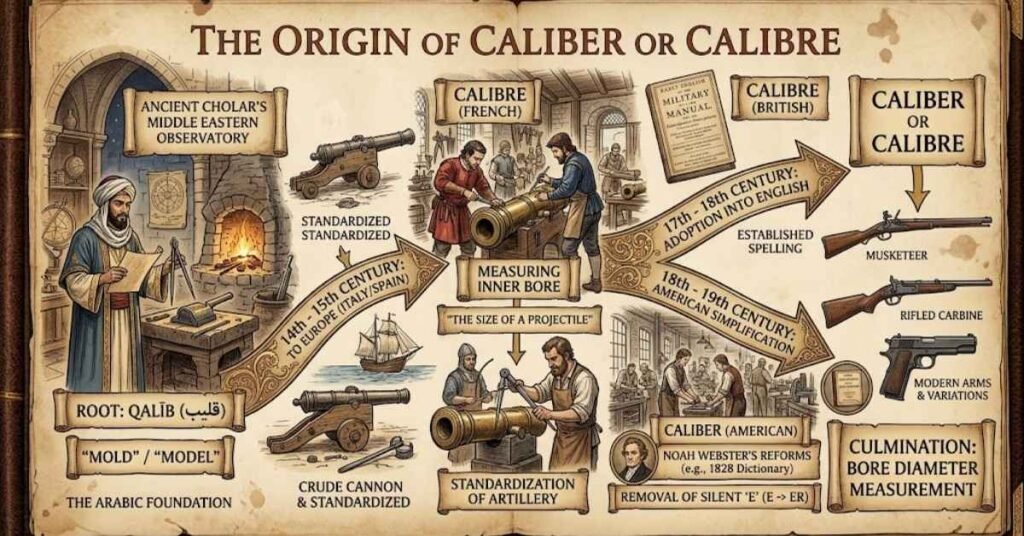
The word came into English from the French language in the late 1500s. French had picked it up from Italian, and many etymology sources trace it back to the Arabic word qalib, which means a mold.
At first, people used it for the inside width of a gun barrel. Over time, the word origin stretched into a handy way to rate people. That’s how a .45 caliber pistol and a surgeon of great caliber ended up sharing one word.
The French word calibre explains the odd -re ending. English kept that spelling for centuries, and Americans only changed it later.
British English vs American English Spelling
Noah Webster led the American spelling reform in the early 1800s. He wanted words to look simpler and match how people say them, so “centre” became “center” and “calibre” became “caliber.”
Britain kept its British spelling conventions, which follow the French style. That’s why you see -re endings in centre, theatre, litre, metre, and calibre.
Other countries split along similar lines. Commonwealth English in India, Pakistan, Australia, and New Zealand generally follows British habits. Canada mixes both, though calibre shows up often there.
Which Spelling Should You Use?
Your choice comes down to one question: who’s reading? The correct spelling is the one your target audience expects.
Think of it like ordering tea. You’d say “chai” in one place and “cuppa” in another, and both work. The word choice just needs to fit the room.
Use caliber when:
Your readers live mostly in the United States, or your style guide follows American rules. AP and Chicago both prefer caliber.
It also fits US audience content like a Texas gun-shop blog or a Silicon Valley hiring page. Brand names keep their own spelling, so “Dodge Caliber” stays exactly as the carmaker wrote it.
Use calibre when:
Your readers sit in the United Kingdom, India, Pakistan, Australia, or Ireland. British spelling rules call for calibre in all those places.
It’s also the safer pick for formal UK content like a London law firm’s website. Outlets such as the BBC and The Guardian use calibre in their copy.
Audience guidance:
Writing for a global audience? Choose one preferred spelling and apply it everywhere. Reader expectations matter more than the spelling itself.
Check your analytics before you decide. If most visitors come from the US, go with caliber. If they come from the UK or South Asia, go with calibre.
Common Mistakes with Caliber or Calibre
Most errors aren’t about picking the wrong version. They’re about sloppiness, and a quick proofreading pass catches almost all of them.
Here are the slips that show up most:
- Mixed spelling: Writing “caliber” in paragraph one and “calibre” in paragraph four.
- Caliper confusion: A caliper is a measuring tool, while caliber is a level or a size.
- Odd misspellings: Typos like “calibur” or “calliber” slip past tired eyes.
- Wrong language setting: Your spellchecker flags a correct word because it’s set to the other English variant.
- Changing proper names: Rewriting a brand or title to match your style, such as Dodge Caliber.
There’s one more trap worth knowing. “Calibrate” comes from the same root, but it’s spelled the same everywhere, so don’t change it.
Caliber or Calibre in Everyday Examples
Seeing the word in action helps more than any rule. Let’s walk through example sentences for five common settings.
Notice how each one stays consistent inside its own piece. That’s the whole trick.
Emails
Imagine you’re writing to a UK client. You’d say, “We’d love a speaker of your calibre at our June event.”
Writing to a US vendor? Switch it to “We’re looking for a team of your caliber.” Either way, the email writing reads clean and natural.
News
News writing follows the outlet’s house style without exception. A Washington paper runs “a high-caliber recruit,” while a Manchester paper runs “a high-calibre recruit.”
Reporters rarely choose. The editorial consistency comes from the style guides and the copy desk.
Social Media
Social media is looser, and readers forgive spelling swings. A tweet like “That goal was pure calibre” feels fine in a Lahore or London feed.
Still, match your followers. If your page speaks to US fans, “That was a caliber performance” fits better.
Formal Writing
Formal writing and academic writing demand one spelling convention from start to finish. A thesis at a UK university should read “research of high calibre” throughout.
Journals often publish their own rules. Check the author guidelines before you submit, since academic content gets rejected over smaller things.
Business Writing
In business writing, professional communication builds trust through small details. A proposal that says “caliber” on page one and “calibre” on page five looks careless.
Set the language in your document template. Then every business professional on your team stays aligned without thinking about it.
Caliber or Calibre – Usage Data
I won’t throw made-up percentages at you. Search numbers shift every month, and you can check Google Trends or Search Console for live figures.
What I can share is the pattern behind them. Search intent here is simple, and the picture stays steady year to year.
Why people search this keyword:
Most people feel spelling confusion while writing something that matters. They want a fast, trustworthy answer so they can hit send.
Students, freelancers, and marketers lead the pack. They ask whether one version is wrong, and the honest answer is no.
Popular regions:
The United States and the United Kingdom drive most of the curiosity. India and Pakistan follow, since writers there often switch between American English and British English.
Canada and Australia show interest too. Their regional differences create the same doubt.
Usage contexts:
People look up the word for job references, sports commentary, product reviews, and firearms articles. The meaning shifts slightly with context, but the spelling difference never does.
You’ll also see it in online content about quality, such as “a skilled professional of rare caliber.” Writers reach for it when plain words feel flat.
Comparison Table (Keyword Variations)
This table lays out the keyword variations side by side. Use it as a quick word comparison when you’re editing.
| Variation | Style | Common in | Example |
| Caliber | American spelling | United States | A player of real caliber |
| Calibre | British spelling | UK, India, Pakistan, Australia | A writer of real calibre |
| Calibers | Plural, American | United States | Rifles in three calibers |
| Calibres | Plural, British | UK and Commonwealth | Rifles in three calibres |
| High caliber | American phrase | US business and sports | A high caliber hire |
| High calibre | British phrase | UK business and sports | A high calibre hire |
Singular and plural forms follow the same rule. Just add an s to whichever spelling you picked.
How to Remember the Difference
Here’s a trick I use. The -re ending looks a bit more French, and calibre is the version closest to its French roots.
The -er ending feels like the shortcut. It’s the same shortcut that turned “centre” into “center,” and Americanization of English has done that for two centuries.
If that doesn’t stick, tie it to your keyboard language. US keyboard, caliber. UK keyboard, calibre.
Pronunciation and Word Meaning
Good news here, since there’s nothing to learn. Both spellings sound the same, roughly “KAL-uh-ber,” and the pronunciation doesn’t change by region.
The definition has two main senses. One is the internal diameter of a barrel or bullet, and the other is the quality or standard of a person or thing.
Every dictionary spelling agrees on those two word meanings. Merriam-Webster lists caliber first, while Cambridge Dictionary, Collins Dictionary, and the Oxford English Dictionary show calibre as the British form.
Caliber vs Calibre in Firearms Writing
Firearms are where this word started, so it’s worth a look. A “9mm caliber” round and a “9mm calibre” round are identical, and only the spelling changes.
Readers there care about accuracy, so be careful with the number format. Use .45 caliber in the US, and write “.45 calibre” if you’re publishing in Britain.
Technical manuals add another wrinkle. Many follow English orthography from the manufacturer’s home country, so match the source when you quote it.
Does Spelling Choice Affect SEO?
Google understands both words and treats them as one idea. A page about calibre can still show up for “caliber” searches.
Still, you should think about your readers. If you target the US, write caliber in headings and body text, and mention calibre once for variety.
Set your page language tag, such as en-US or en-GB, so browsers and tools know your English variant. Then keep writing consistency across the whole site.
A Quick Pre-Publish Checklist
Run through these steps before you hit publish. It takes under two minutes and saves embarrassing edits later.
- Confirm the target audience and match the spelling to it.
- Search the document for both versions and fix any inconsistent spelling.
- Check that brand and product names keep their original form.
- Set your spellchecker to the right English language variant.
- Read one sentence aloud to catch anything that sounds off.
Strong copy editing habits make writing accuracy feel effortless. Over time, you won’t even need the list.
Conclusion
Caliber and calibre mean the same thing, so neither one is wrong. The only real question is who you’re writing for.Go with caliber for American readers and calibre for British and most Commonwealth readers. Then keep it consistent and double-check proper names.
Did this clear things up for you? Drop a comment with the spelling quirk that trips you up most, and share this guide with a friend who writes a lot.
FAQs
1. Is “caliber” correct?
Yes, it’s fully correct. Caliber is the standard US spelling, and every American dictionary lists it first.
You can use it with confidence in the United States and anywhere your audience prefers American English.
2. Is “calibre” correct?
Yes, and it’s just as valid. Calibre is the standard in UK English and across British English regions.
It’s the right call for readers in the UK, India, Pakistan, Australia, and similar places.
3. Do both words mean the same?
They do, without exception. Both refer to the size of a gun bore or the quality of a person.
Only the spelling differs. The definition and pronunciation stay put.
4. Which spelling is more common?
It depends on where you look. Caliber dominates in the US, which has a huge online content footprint, while calibre leads in the UK and much of the Commonwealth.
For a hard number, check Google Trends for your own country and timeframe.
5. Can I use both in one document?
You shouldn’t. Mixed spelling within one piece looks careless, and it hurts professional writing.
The only exception is quoting a source or proper name that uses the other version. In that case, keep the original.
6. Is there a difference in meaning?
No difference at all. Caliber and calibre carry the same meaning in every setting, from sports to business communication.
The confusion with “caliper” is a separate issue, since that’s a different word and a different tool.
7. Which should I use for global writing?
Pick the spelling your largest reader group expects. If you can’t tell, caliber works well for most global audience sites, though calibre suits UK and South Asian readers better.
Whichever you choose, apply it everywhere and set your language tag. That keeps your writing style tidy and trusted.