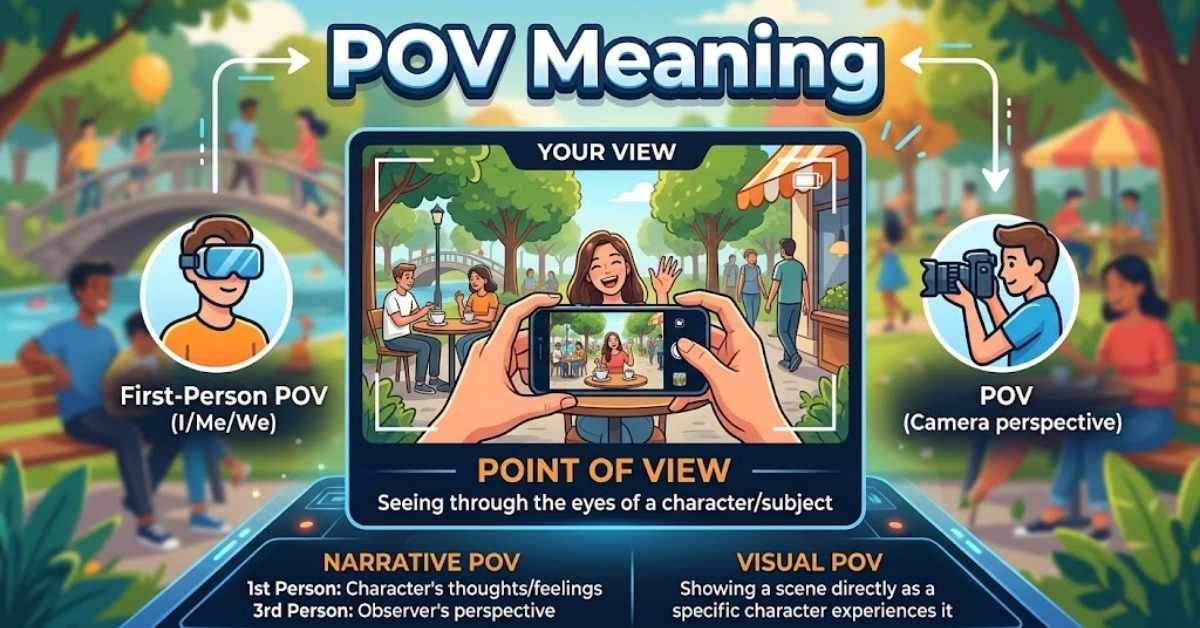

POV stands for point of view. In text and on social media, it points to a specific angle on a situation, so you can see the moment through someone’s eyes.
Ever spotted “POV: you’re the last one awake at a sleepover” and wondered what it meant? You’re not the only one. This guide explains the meaning of POV in plain talk, with real examples you can use today.
POV – Quick Meaning
Think of POV as a tiny invitation. It says, “Picture yourself right here.” That’s why POV slang feels so personal and so quick to get.
Simple Definition:
POV means point of view. It’s your personal perspective on a scenario, shared as if the reader is living it.
Online, it works as internet slang for “imagine this from my side.”
Quick Examples:
- POV: you finally reply to a text after three days.
- POV: your alarm rings and you’re not ready for Monday.
- POV: you walk into the exam hall and forget everything.
Origin & Background
POV didn’t start on a phone. It grew out of how we tell stories, and the internet simply gave it a new coat of paint.
Traditional Meaning
In literature, film, photography, writing, and journalism, point of view means who tells the story. First person point of view uses “I,” second person point of view uses “you,” and third person point of view uses “he” or “she.”
In film, a POV shot is a camera angle that shows exactly what a character sees. Think of a hallway shot where you feel the footsteps.
How It Became Internet Slang
Gamers and video editors borrowed the idea first. Then TikTok, Instagram Reels, and YouTube Shorts made it a viral trend, because short-form video platforms reward quick mini stories.
Creators started typing “POV:” in captions to drop viewers into a scene. Soon it spread to memes, tweets, and comment sections, and it became part of everyday digital culture.
Real-Life Conversations
You’ll see POV most in online communication. Here’s how it sounds in five common places.
1) WhatsApp Chat
A friend sends, “POV: I said ‘five minutes’ and it’s been an hour.” Everyone in the WhatsApp chats group knows exactly who’s running late.
2) Instagram DMs
You get a reel with “POV: your best friend after you ghost the group.” It’s a playful nudge inside Instagram DMs, not a real accusation.
3) TikTok Comments
Someone writes, “POV: you read the comments before watching the video.” It’s a fast, relatable joke that earns likes in seconds.
4) Text Message
In text messages, a short “POV: me trying to adult today” signals a mood. It’s casual communication without a long explanation.
5) Funny Friend Chat
In group chats, POV becomes a running gag. One friend sets the scene, another adds a twist, and suddenly you’ve built a mini story together.
Emotional & Psychological Meaning
POV is more than a trend. It taps into shared experience and human connection, which is why it sticks.
1) It Makes People Feel Seen
When a POV nails your everyday struggles, you think, “That’s literally me.” That feeling of relatability can ease social anxiety and loneliness.
2) It Creates Instant Connection
A single line builds emotional connection fast. You don’t need a long backstory, only a shared feeling.
3) It Reflects Modern Identity
People use POV for identity expression and self-expression. It shows how you see your day, your crush, your family dynamics, and yourself.
4) It Feels Personal Without Being Too Deep
You can admit disappointment or embarrassment in a joking tone. It offers emotional honesty without the weight of a heavy talk.
Usage in Different Contexts
POV changes shape depending on where you drop it. A tone that works with friends can flop at the office, so context matters.
1) Social Media
This is where POV feels most at home. Content creators use it daily for audience engagement.
How it works:
You type “POV:” and then describe a scenario in second person. The viewer fills in the blanks and feels part of the story scene.
Example:
POV: you’re editing a reel at midnight and the caption still isn’t right.
Purpose:
It grabs attention, sparks relatable content, and invites comments. That’s why you’ll find it in social media captions everywhere.
2) Friends & Relationships
Among friends, POV adds humor and warmth. In dating culture, it can also hint at feelings you don’t want to say out loud.
Example:
POV: you’re pretending not to check if your crush viewed your story.
Example:
POV: your sibling borrowed your hoodie again and acts innocent.
3) Work or Professional Settings
POV can show up in workplace culture, but you need a light touch. Keep it friendly and clear.
Appropriate professional uses:
- Marketers shaping customer journey stories
- Team presentations showing a user viewpoint
- Content strategy sessions that map the user experience
Example:
“POV: a customer lands on our checkout page and can’t find the promo box.” It helps your team feel the problem fast.
Important:
Skip the jokes in formal communication, like emails to clients or HR. When in doubt, say “from the customer’s perspective” instead.
4) Casual vs Serious Tone
POV can be playful or thoughtful. Your communication style decides which one lands.
Casual POV
Playful tone: “POV: you open your inbox on Monday.” It’s light, quick, and meant for a laugh.
Serious POV
Reflective tone: “POV: you’re learning to set boundaries with family.” It carries emotional growth and deserves a gentler reply.
Common Misunderstandings
POV looks simple, but people trip over it all the time. Here are the three mistakes I see most.
1) Using POV for Something That Isn’t a Perspective
POV needs a viewpoint. “POV: pizza is round” isn’t a scenario, it’s just a fact.
Ask yourself, “Whose eyes are we looking through?” If there’s no answer, skip POV.
2) Confusing POV With Opinion
An opinion says what you think. A POV shows what you see or feel in a moment.
Example:
Opinion: “IMO, Mondays are awful.” POV: “POV: it’s Monday and your coffee machine just died.”
3) Using It in Very Serious Situations Without Sensitivity
Humor can hurt when someone’s hurting. A careless POV can look mocking, even if you meant well.
Avoid using it when:
- Someone is grieving or sharing mental health struggles
- The topic involves harm, abuse, or tragedy
- You don’t know your audience well
Comparison Table
People mix POV with similar terms all the time. This quick table clears it up.
| Term | What It Means | Best Used For |
| POV | A scenario-based perspective | Mini stories, captions, jokes |
| Opinion (IMO) | What you personally believe | Debates, reviews |
| FYI | Info shared for awareness | Updates, work notes |
| Detached description | A neutral account, the opposite of POV | Reports, news |
Key Insight:
POV shows a moment from inside. Opinion states a belief, and FYI shares a fact. Pick the one that matches your goal.
Variations / Types of POV
POV comes in many flavors. Here are ten you’ll spot daily across internet culture.
1) Funny POV
Built for laughs and relatable jokes. Example: “POV: you said ‘one episode’ at 9 p.m.”
2) Romantic POV
Soft, sweet, and a bit dreamy. Example: “POV: they remember your coffee order.”
3) Sad POV
Quiet and honest. Example: “POV: you smile through a party while feeling lonely.”
4) Confidence POV
Bold and proud, often tied to a glow-up or main character energy. Example: “POV: you finally walk in like you own the room.”
5) Friendship POV
Pure friendship dynamics. Example: “POV: your friend cancels plans and you secretly cheer.”
6) Family POV
Think family humor and family pressure. Example: “POV: your mom asks about marriage at a cousin’s party.”
7) Student POV
Full of exams, deadlines, and campus life. Example: “POV: you study for an hour and call it a full day.”
8) Work POV
Packed with meetings, burnout, and work stress. Example: “POV: the meeting could’ve been an email.”
9) Fashion or Beauty POV
Common in fashion content and makeup content. Example: “POV: you try five outfits and wear the first one.”
10) Cinematic POV
Shot like a movie, with cinematic storytelling and slow camera moves. It gives that aesthetic content vibe people love.
How to Respond When Someone Uses It
Replying well builds social connection. Match their mood, and you’ll rarely go wrong.
Casual Replies
“Too real.” “This is literally me.” Short and easy, they keep the chat moving.
Funny Replies
Add a twist. If someone writes “POV: Monday morning,” try “POV: me hitting snooze for the fifth time.”
Mature / Confident Replies
Stay calm and clear. Something like, “Fair point, I see where you’re coming from,” shows emotional intelligence.
Private or Respectful Replies
If the post feels heavy, reply privately. A simple “I’m here if you want to talk” respects their vulnerability.
Regional & Cultural Usage
POV is global, yet each region gives it a slightly different spin. Cross-cultural communication shapes how people read it.
1) Western Culture
In the United States, United Kingdom, Canada, and Europe, POV leans playful and ironic.
Common style:
Self-aware humor about dating confusion, jobs, and adult life humor.
2) Asian Culture
POV often reflects student pressure and family expectations. It’s a gentle way to vent without causing a scene.
Common style:
Relatable school, exam, and parent relationships stories, usually light and warm.
3) Middle Eastern Culture
Social expectations and respect-based communication guide how POV appears. Humor stays warm and family friendly.
Common style:
Gathering scenes, sibling relationships, and home life moments.
4) Global Internet Usage
Online, borders blur. Online communities share the same POV formats, so a joke from Karachi can land in Chicago within hours.
Why Creators and Marketers Love POV
POV turns viewers into participants. That’s gold for audience engagement and branding.
Brands use marketing storytelling to show the customer experience from the buyer’s side. It feels real, not salesy.
How to Write Your Own POV (Step by Step)
Try this simple flow. It works for captions, reels, and chats.
- Pick one moment. Keep it small and specific.
- Use “you.” Make the reader the star.
- Add one honest detail. A tiny truth makes it relatable.
- Match the mood. Playful, sad, or confident, choose one.
- Keep it short. One line often does the job.
Got a favorite POV you’ve seen lately? Drop it in the comments and share this guide with a friend who’s still confused.
Conclusion
POV is a digital expression that turns a plain situation into a shared moment. It’s quick, relatable, and rooted in the old idea of narrative perspective.
Use it with care, match your tone, and know your audience. Do that, and you’ll speak modern slang like a native.
FAQs
1) What is the exact meaning of POV?
POV means point of view. It describes a viewpoint or specific angle on a moment.
2) What does POV mean on TikTok?
On TikTok, it sets a scene so viewers feel they’re inside the story. Creators use it as a caption hook.
3) Is POV slang?
Yes and no. “Point of view” is standard English, but “POV:” as a caption format is online slang terms territory.
4) Can POV be used in texting?
Absolutely. Friends use it in texting language to share moods, jokes, and quick mini stories.
5) Is POV always used correctly online?
Not really. Many people use it for plain facts or opinions, which misses the scenario-based idea.
6) What’s the difference between POV and opinion?
POV shows a moment through someone’s eyes. An opinion states what someone believes.
7) Is POV formal or informal?
Mostly informal. Use it with friends and online, and keep it out of formal communication unless you’re discussing a user viewpoint.